Male and Female Weed Plants: How to Tell Them Apart
Cannabis plants are usually either male or female. Only the females grow the big, resinous buds people smoke or vape, so most growers want female plants and nothing else. Males make pollen, and once that pollen lands on a female she puts her energy into seeds instead of flowers. A third group, hermaphrodites, carries both male and female flowers on one plant.
This guide explains how to tell the sexes apart, why a seedless female (sinsemilla) is the goal for most growers, how feminized seeds are made, and why a feminized plant can still surprise you with pollen sacs.
Understanding the sex of weed plants
Botanists call cannabis dioecious: male and female flowers normally grow on separate plants. Sex is set by chromosomes, much like in people. Females carry two X chromosomes (XX) and males carry an X and a Y (XY). A research team in Lyon mapped these sex chromosomes and found that the largest chromosome pair in the cannabis genome is the sex pair (Prentout et al., 2020).
How a plant actually flowers also depends on its hormones, its age and the conditions it grows in. This is also how a genetically female plant can sometimes grow male flowers, which we come back to further down.
How do you tell male and female weed plants apart?
You can't see the sex on a seedling. The first clues appear at the nodes, the points where side branches leave the main stem. Researchers in Israel observed that cannabis forms single flowers at the nodes even under long days, when growers think of the plant as purely vegetative, and concluded that this is most probably driven by the plant's age and internal signals, not by the light schedule (Spitzer-Rimon et al., 2019). These early flowers are what growers call pre-flowers.
Female plants
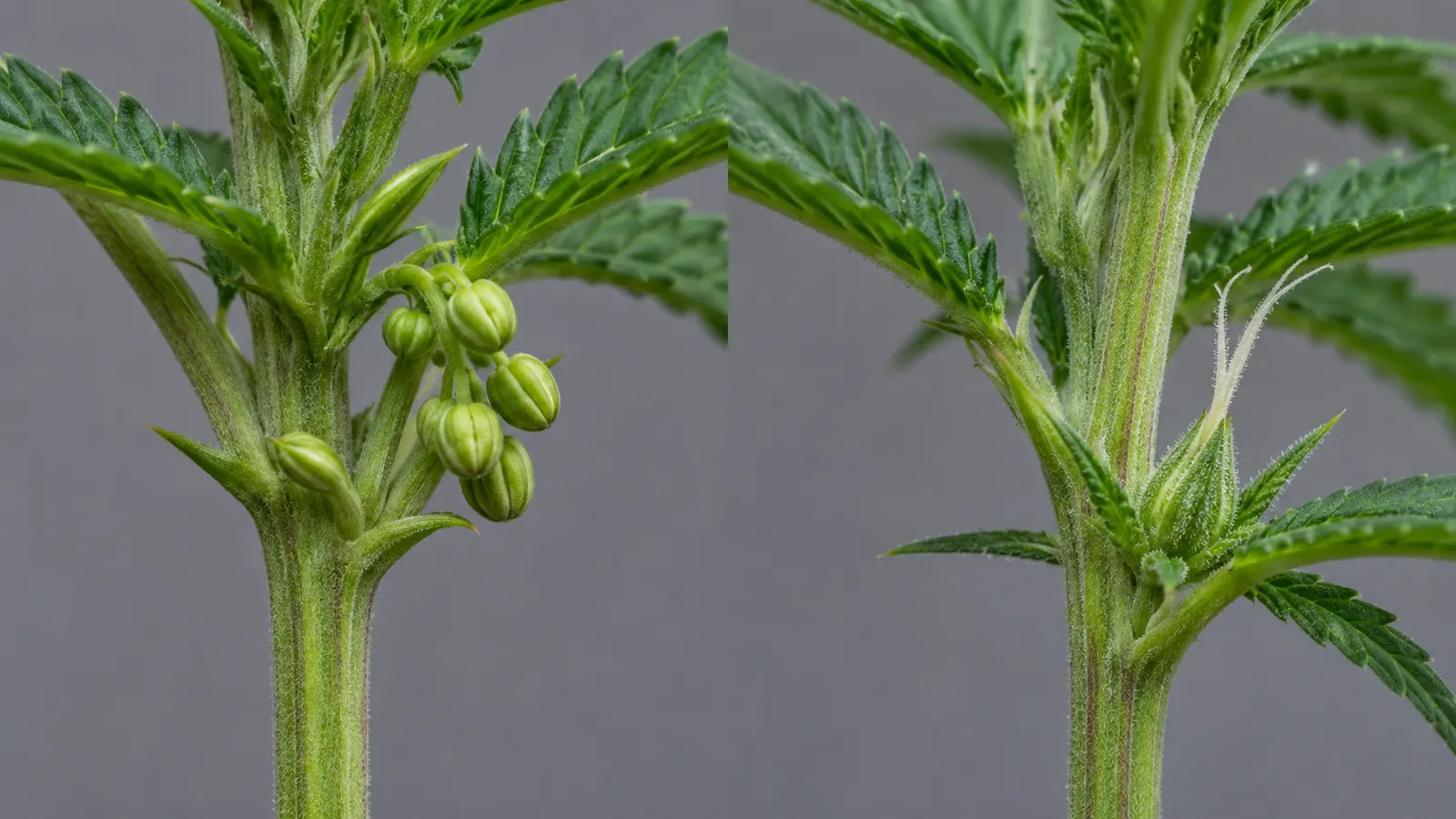
A female pre-flower is a small, pointed green bract with one or two fine white hairs (the stigmas, which growers often call pistils) sticking out of the tip. Over the following weeks of flowering these grow into clusters that become the buds you harvest.
Male plants
A male pre-flower is a small round ball on a short stalk, with no hairs. These are pollen sacs. As flowering goes on they form clusters that look a bit like tiny bunches of grapes, and when they open they release pollen.
Hermaphrodite plants
A hermaphrodite shows both: female bud sites with white hairs, plus pollen sacs somewhere on the same plant. Sometimes the male part is not a round sac but a small yellow-green banana-shaped anther growing straight out of a bud. Growers call these "bananas" or "nanners". They can release pollen too.
If you are unsure, wait a few days and look again with a magnifier. A hair appearing is a female sign. A round ball that keeps swelling without any hair is male.
Why female plants make the buds you smoke
If you are into cannabis consumption, whether in a joint or through a vaporizer, what you use is the flower buds of the female plant. Those buds are covered in resin glands (trichomes), and that is where the plant stores most of its cannabinoids and terpenes.
A male plant does not produce these large resinous tops. Its job is reproduction: it makes pollen and nothing much else that a home grower wants to harvest.
Can you find out a plant's sex earlier?
Looking at pre-flowers works, but it means growing every plant for several weeks first. Labs can find the sex sooner from a small tissue sample. In a Canadian study on hermaphrodite plants, a DNA test (PCR) found a fragment that was uniquely associated with male plants, which points to a way of identifying males from their genetic material instead of their flowers (Punja & Holmes, 2020). The 2026 review assesses current approaches for early detection, including visual inspection, Raman spectroscopy and sex-linked molecular markers (Richards et al., 2026).
For most home growers this is more effort than it is worth. Feminized seeds take the question away before you start, and with regular seeds a sharp eye on the nodes does the job.
What pollen does to your harvest
When pollen reaches a female flower, that flower starts to make a seed. Growers have long found seeded buds weaker, and a study in Israel measured the effect. The researchers crossed THC-rich and CBD-rich female plants with several different males and compared the flowers with unpollinated ones. Fertilization lowered the concentration of nearly all cannabinoids, whichever male was used. The cannabinoid profile stayed the same, but there was clearly less of it (Lipson Feder et al., 2021).
So growers aim for sinsemilla, Spanish for "without seed": female plants that never see pollen. One male plant in a tent or a garden is enough to put seeds in your buds, so males are removed as soon as they are recognized, unless you want to breed.
Regular seeds: roughly half male, half female
Seeds from a normal cross between a male and a female plant are called regular seeds. In the same Canadian study, seedlings from cross-fertilized seeds came out at about one male for every female (Punja & Holmes, 2020). So if you germinate ten regular seeds, expect around half to be males, though in a small batch the split can easily be off.
Regular seeds still have a place. You need males to breed, and some growers like working with plants that come straight from a male-female cross. Our grower Jan van Amsterdam says his personal preference is regular seeds and pure strains.
What are male plants good for?
For a grower who only wants buds, a male plant has no use and takes up space. For a breeder it is half of every new strain. Each regular seed carries genes from a mother and a father, and the father's pollen is how traits from one line reach another. Breeders choose their males carefully for exactly that reason, even though a male never produces a bud of its own.
If you keep a male to make your own seeds, grow it well away from the females you want to harvest seedless. Pollen is light, and a single open flower cluster releases a lot of it.
How feminized seeds are made
Feminized seeds are made without a male plant. The breeder takes a female plant and makes her grow pollen sacs, usually by spraying her with silver thiosulfate (STS). This compound blocks the action of the plant hormone ethylene. In a 2026 trial in Australia, STS caused strong female-to-male reversion, and in the treatment that worked best, STS combined with gibberellic acid, all the sex-reverted flowers were fertile (Garcia-de Heer et al., 2026). A review from Colorado State University Pueblo calls silver-based ethylene inhibitors such as STS the most effective tools for feminized seed production (Richards et al., 2026).
The pollen from that treated female only carries X chromosomes, because she has no Y to pass on. When it fertilizes another female, the seeds are female too. The Canadian study saw the same thing with hermaphrodite flowers: seeds formed on hermaphroditic plants gave rise only to genetically female plants (Punja & Holmes, 2020).
Why feminized seeds save time and space
With regular seeds you have to grow every plant until it shows its sex, then remove the males. That costs weeks of light, nutrients and space for plants you throw away. With feminized seeds, almost every plant you germinate can go on to produce buds. For a small tent or a balcony with room for only a few plants, that makes a big difference.
You will find them in our feminized seeds range, from classics to high THC strains.
Can a feminized plant still turn hermaphrodite?
Yes, it can happen. The 2026 review describes sex expression in cannabis as "highly plastic": genetics, hormones, the plant's stage of development and its environment all play a part, and environmental stress is one of the factors studied in sex instability (Richards et al., 2026). A hermaphrodite in a grow room can pollinate itself and its neighbours, which leaves seeds in the buds and weakens the harvest.
"Why did my feminized plant turn hermaphrodite?" is one of the questions we get from growers. We asked Jan how often he sees it and what the usual cause is. His answer: rarely to never. Mostly it comes down to stress, from light stress and poor genetics, and he has seen both himself on the odd occasion.
Common grower advice to keep that risk low:
- Keep the dark period truly dark during flowering. Light leaking into a tent at night is a typical form of light stress.
- Avoid big swings in temperature and long dry spells, especially late in flowering.
- Buy seeds from a seed bank that selects its parent plants, so poor genetics is less likely.
- Check your plants regularly in the first weeks of flowering, so you spot pollen sacs or bananas before they open.
If you find a few bananas late in flowering, some growers pick them off carefully and keep a close eye on the plant. If a plant is covered in pollen sacs, it is safer to remove it before it pollinates the rest.
Our weed seed selection
If you want to grow your own buds without having to sort out males, feminized seeds are the easiest route. For a fast and compact grow, look at our AMS SUPREME auto-fem seeds, which combine autoflowering with feminized seeds. Not sure about autoflowers? Our guide what are autoflower seeds explains how they differ from regular photoperiod plants.
Frequently asked questions
What is the difference between male and female weed plants?
Male plants grow round pollen sacs and pollinate females. Female plants grow buds with white hairs (stigmas) and resin glands. The buds people smoke come from female plants.
How can I tell if my weed plant is male or female?
Look at the nodes where side branches meet the main stem. A small pointed bract with white hairs means female. A small round ball on a short stalk, without hairs, means male. Both show up as pre-flowers before full flowering starts.
Can a male weed plant produce female seeds?
A male plant does not produce seeds itself. Seeds grow on the female after she is pollinated. Seeds from a male and female cross are regular seeds, with roughly half female and half male plants.
What are feminized seeds?
Feminized seeds are made by pollinating a female plant with pollen from another female that was made to grow pollen sacs, usually with silver thiosulfate. Because no Y chromosome is involved, the seeds grow into female plants.
Are feminized seeds 100% female?
Nearly all of them grow into females, but a feminized plant can still show male flowers under stress or because of its genetics. Good genetics and a stable growing environment keep that risk low.
What are hermaphrodite cannabis plants?
Hermaphrodite plants carry both male and female flowers. They can pollinate themselves and the plants around them, which puts seeds in the buds and lowers their strength.