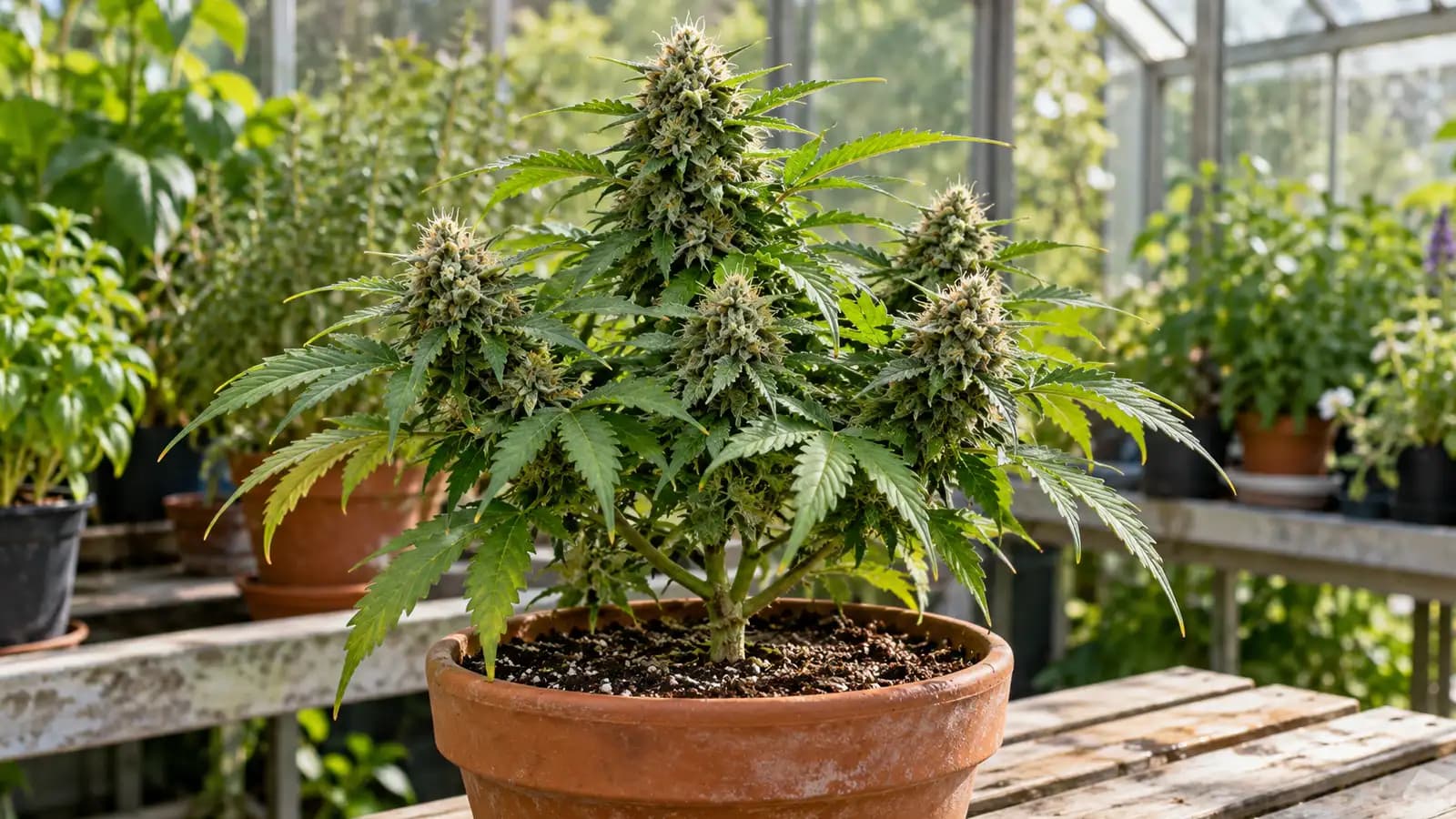
Uneven Autoflower Growth: What Is Normal?
Uneven autoflower growth is normal up to a point, because plants from one pack rarely grow at exactly the same speed. A small gap in height is fine: same genetics, but every seedling gets a slightly different start in the pot. A gap that keeps widening, or a plant that looks different in leaf shape, structure and flowering time, points to something else: root space, water, light, stress, or in rare cases a plant that is not the same type. This guide shows how to tell the two apart.
Why do autoflowers from the same pack grow at different speeds?
Seeds from one pack share a parent line, but they are not clones. Each seed is a new combination of genes, so even healthy siblings differ a little in how fast they germinate, how quickly the root takes off and how tall they stretch. Clones are the only plants that start truly equal.
An autoflower makes this more visible than a photoperiod plant. It flowers on age, not on a light switch, so the vegetative stage is short. A photoperiod plant can keep growing under long days until the smaller ones catch up. An autoflower has no waiting room: a plant that loses a week early on is often still a week behind when the others start to flower.
Our support team hears the same worry again and again: a few plants out of a batch are clearly smaller, and the grower fears wrong seeds. In the conversations we see, the usual explanation is not the seeds. Soil, water, light, stress and the individual plant (the phenotype) together explain most of the difference.
What does the research say about variation in autoflowering plants?
The autoflowering trait is genetic. In a 2022 study, Toth et al. in Frontiers in Plant Science mapped the locus behind it, which they named Autoflower1, and a second locus that affects flowering time, Early1. The authors describe photoperiod insensitivity as a trait that has anecdotally been called a simple recessive one.
The same paper notes something useful for this topic. The authors had earlier found populations marketed as F1 hybrids in which individuals had two distinct flowering times, roughly a month apart. That is a statement about hemp populations in a study, not about any particular seed pack, but it shows that flowering time can differ strongly between plants that are sold as the same thing when the genetics are not fully fixed.
A broader overview by Steel et al. (2023) collects the known flowering time loci of Cannabis sativa on one reference genome. Their point is that flowering behaviour is controlled by several places in the genome, which is one reason that no two seedlings behave identically.
The practical reading: some spread is built in, and it is larger when the line is less stable. Breeders have worked on stabilising the trait, and the overview on Wikipedia notes that early autoflowers were not always stable, which let non-autoflowering and weak plants reach the market. A well-bred line is more consistent, but never perfectly so.
What is normal and what is not?
Use this as a rule of thumb. It is our reading of the evidence above plus basic plant care, not a measurement.
Normal
- One or two plants a bit shorter or taller than the rest in the first weeks.
- Slightly different leaf size or node spacing, with the same leaf shape and the same general look.
- A plant that starts showing pistils a few days before or after the others.
- A smaller plant in a corner of the tent that gets a little less light than the middle.
Worth investigating
- A plant that stays at seedling size for weeks while others are in full growth.
- Yellowing, curling or spotted leaves on only some plants. See our guide to cannabis leaf problems.
- Whole rows of plants that are small, which usually means the setup is the cause, not the seed.
- A plant whose structure clearly differs: much taller and stretchier, or a different leaf pattern.
Possibly a different type
If one plant develops differently in every respect and keeps going in vegetative growth long after the others have flowered, you may have a plant that does not carry the autoflower trait. For the genetics behind this, see what autoflower seeds are. Some growers only notice late that they have a different type than they meant to order (autoflower, feminized or regular), so check the product code of your order before drawing conclusions.
What Jan van Amsterdam says about size differences
We asked Jan van Amsterdam how much size difference is normal among autoflowers from one pack. His answer, word for word: "het is de zelfde genetica, verschil kan niet al te groot zijn. Ik schat als er echt een uitschieter tussen zit, dan valt dat op en als het zich dan ook nog echt anders ontwikkelt, dan is het helemaal duidelijk."
In plain English: same genetics means the difference should not be too big. A real outlier stands out, and if it also develops in a clearly different way, there is no doubt that something is off.
Jan also recommends autoflowers as a first grow. Asked whether he would advise a beginner to start with one, he said: "Ja, het maakt het een stuk makkelijker". He advises against topping them as well ("autoflowers niet toppen"), and that matters here, because cutting or bending a plant that has lost time is one of the quickest ways to widen a gap.
The most common reasons for uneven growth
1. Root space and pot size
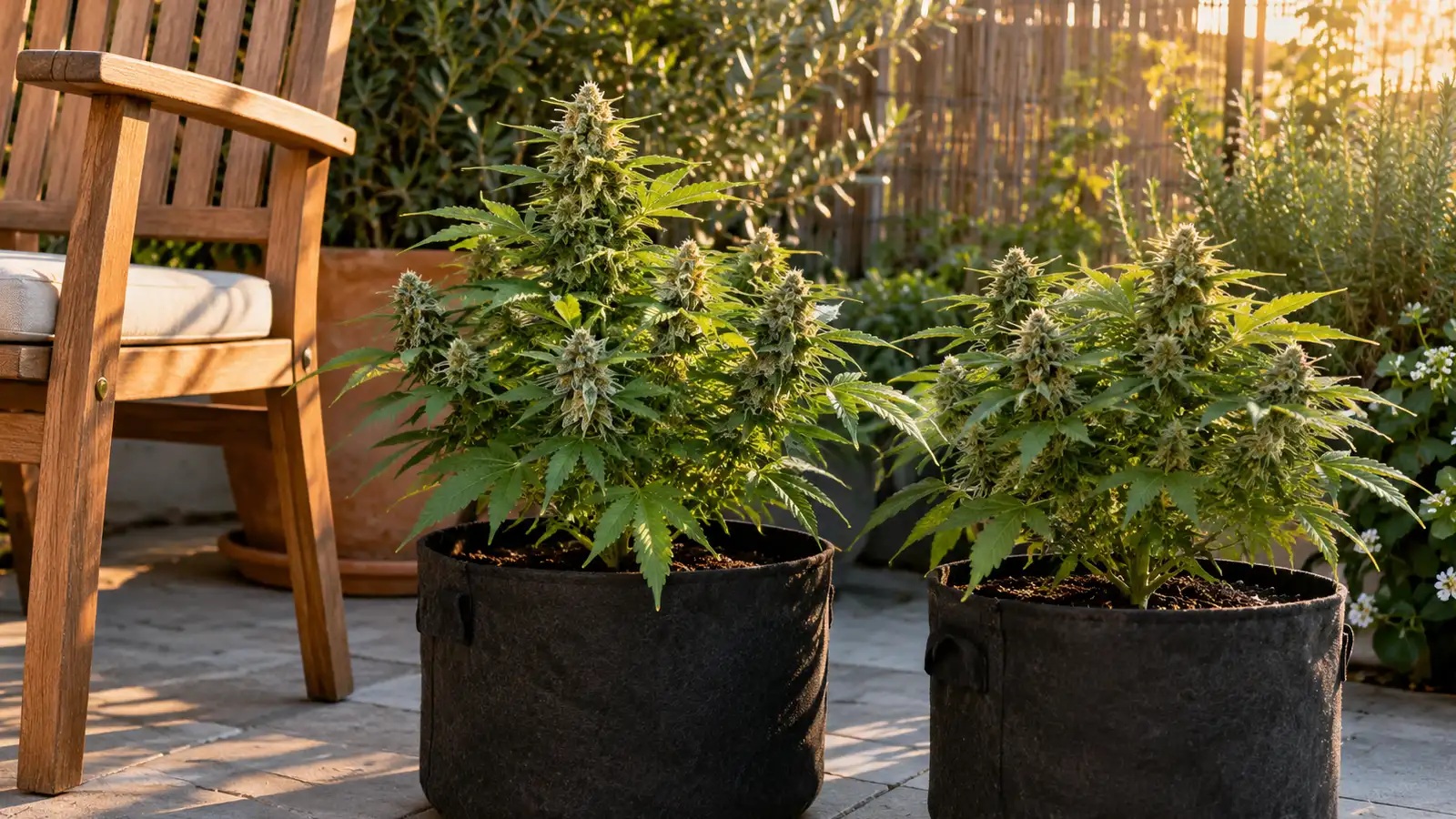
Root volume sets the pace of growth more than most growers expect. A meta-analysis of 65 studies by Poorter et al. (2012) in Functional Plant Biology found that doubling the pot volume increased biomass by about 43 percent on average, mainly because plants in small pots photosynthesise less per unit of leaf area. These were many species, not cannabis alone, so treat the number as a direction rather than a promise.
For uneven autoflowers this has a simple consequence: pots that differ in size, or one plant that was potted up late, will show up as a size gap. Use the same pot for every plant of a batch. Our guide to autoflower pot size explains how pot volume affects final height.
2. Water and the medium
Overwatering and underwatering both slow a seedling, and the effect is unequal when pots dry at different rates. A pot in a warm spot or with a looser mix dries faster than its neighbour. Weigh or lift the pots before watering so each plant gets water when it needs it, not on the same day as the rest. The same medium for every pot matters too: a pocket of compacted or very wet mix can hold one plant back. If you are choosing a mix, see our notes on the best soil for autoflowers and on hydro versus soil.
3. Light distribution
Light is rarely even across a tent. The centre is usually brighter than the edges, and a plant at the edge grows slower than its sibling in the middle. If you see a clear pattern, with the smallest plants always in the same spot, move the plants around every few days or lower the light a little toward the edge. Light that is too close gives a different kind of uneven growth: bleached or burned tops on the tallest plants.
4. Stress early in life
Autoflowers react quickly to stress early on. Moving a seedling roughly, a cold watering, a heat spike under the light or a strong feed can cost a plant days. Because the clock keeps ticking, that loss is not recovered. This is also why we do not top autoflowers, and why heavy training on a small plant can leave it permanently behind its neighbours.
5. Germination and the first week
The seeds that sprout first and have a clean taproot are usually the ones that lead. A seed that emerges two days later will often stay two days behind. Plant seeds at the same depth, keep the start temperature stable and plant them out as soon as the taproot is visible. If several seeds do not germinate at all, read our germination troubleshooting guide and our guide to germinating weed seeds.
6. Nutrients
Autoflowers are sensitive to feed that is too strong. A plant that gets a little more than its neighbour can show tip burn and slow down while the other keeps going. Start light, feed all plants the same way and change one thing at a time. For feed choices, see the best organic fertilizer for autoflowers.
7. The individual plant
Last, some plants are just different. Within one pack, one plant may be a fast starter and another may be slow at first and catch up. This is the phenotype. If the plant is healthy, has the right shape and is only a bit slower, leave it alone. It may still give a good harvest, only a little later.
How to tell a setup problem from a plant problem
A short checklist helps you decide where to look first.
- Is the smallest plant always in the same spot? Then the cause is light, temperature or airflow in that spot, not the plant.
- Are the pots all the same size and the same mix? If not, fix that first.
- Does the small plant look healthy but small? It is likely a slow starter. Keep its care the same as the others.
- Does the small plant have discoloured, curled or damaged leaves? Check water, pH and feed, then use the leaf guide linked above.
- Does the plant look like a different plant in every way? Then compare structure and flowering time with its siblings over two weeks before you decide.
Take a photo of the whole group every few days from the same angle. It makes slow-moving differences easy to see, and it gives you something concrete to show if you contact support.
What to do with the small plants
Do not cull early. A smaller plant usually still flowers on schedule, because autoflowers flower on age. The smaller plant will be lighter, but it often finishes with the others.
- Keep its care the same as the others. Do not overcorrect with extra feed or water.
- Give it a bit more light by moving it, not by lowering the lamp onto it.
- Skip topping and heavy defoliation on the weaker plants.
- Harvest by the plant, not by the calendar: check each plant's trichomes separately if they finish at different times.
How to reduce the spread next time
- Use the same pot, the same medium and the same water volume for each seed.
- Plant the seeds at the same depth, and mark the pots so you can follow each plant.
- Sow one or two more seeds than you need, and grow on the ones that sprout together.
- Keep the light even and rotate plants if the tent has bright and dim spots.
- Avoid strong feed in the first weeks.
If you want to pick a line for your next grow, browse our autoflower seeds. Our overview of autoflower facts covers what to expect in general.
Frequently asked questions
Is it normal for autoflowers from one pack to be different sizes?
A small difference is normal. Siblings share genetics but not an identical start, so germination speed, root growth and light at their spot all play a part. A large difference, or one plant that looks different in every way, is worth investigating.
Does uneven growth mean I got the wrong seeds?
Usually not. Setup and early stress explain most of the gaps we hear about. If one plant develops in a clearly different way from the rest, compare it with its siblings for two weeks and contact our support team with photos.
Will the small plants catch up?
Some will, mainly the ones that were slowed by a short problem that has been fixed. Others stay smaller but still finish with the group, because autoflowers flower on age.
Should I remove the smallest plants?
Not at first. Wait until flowering has started, then decide. A small healthy plant can still give a useful harvest.
Should I top or train the weak ones to help them?
No. Jan van Amsterdam advises not to top autoflowers, and cutting or bending a plant that is already behind usually widens the gap.
Does pot size cause uneven growth?
It can. Root volume has a strong effect on growth in plants in general, so different pot sizes or a late pot-up produce visible differences between plants.
Can I avoid the spread completely?
No, but you can reduce it. Keep pots, medium, water and light as equal as you can, and expect a small spread even then.