How reviews are checked
Both Kiyoh and eKomi invite customers to leave a review after an order. Kiyoh states that it checks reviews for authenticity. The Kiyoh score covers all our reviews to date; the eKomi score covers the last 12 months.
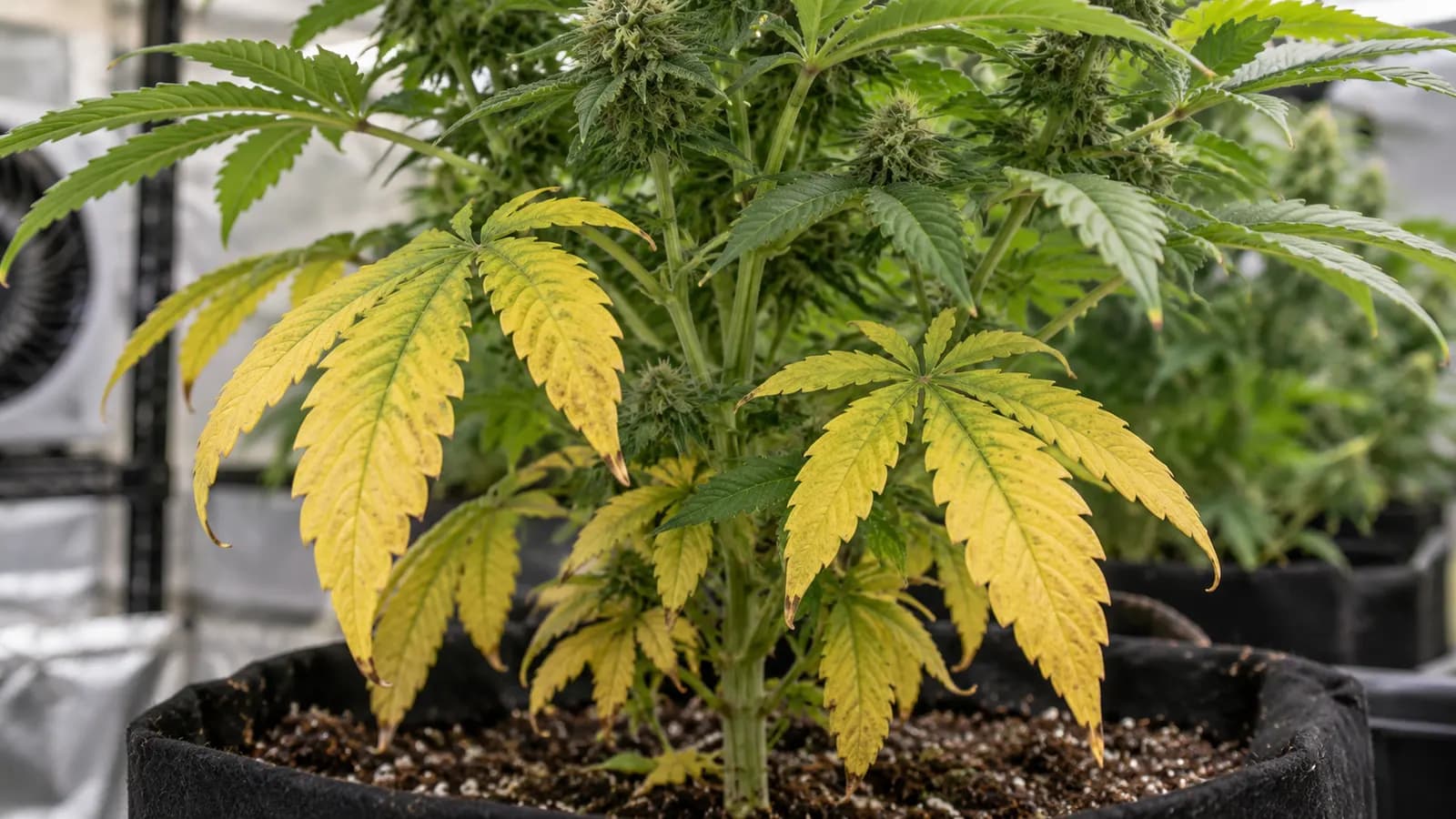
Cannabis Leaf Problems: Yellow, Curling, Drooping, Spots
Most leaf problems on a cannabis plant come from the root zone, not from a missing nutrient. Yellow, curling, drooping or spotted leaves usually mean the roots are sitting in too much water, the pH is off, or the plant is getting more feed than it can use. So the first move is to check the pot and the pH. Adding more nutrients should come last, and with a plant that is already struggling it often makes things worse.
That is also what we tell growers who ask us about a plant that has started to look wrong. Lack of feed does happen, but in our experience overwatering and overfeeding are the more common causes. The rest of this guide works through four common symptoms (yellow, curling, drooping, spots), what each one looks like when it points to a particular cause, and what to do before you reach for a bottle.
Check these two things before anything else
Water
A plant in waterlogged medium has roots that cannot breathe. Water pushes the air out of the pot, and roots need that oxygen to work. A horticulture trade article on overwatering describes limp, wilted, yellowing leaves, soft roots and a plant that becomes more prone to root-rot fungi such as Pythium and Fusarium. The same article notes that once the root fibres die, the plant can no longer take up the moisture it needs, so the leaves go limp even though the pot is full of water.
Lift the pot. As a rough rule, a pot that still feels heavy a couple of days after watering is not asking for a drink. Push a finger a few centimetres into the medium: if it is wet and cool, wait. If you water on a fixed schedule whatever the pot weighs, you will overwater sooner or later, especially with young plants in big pots. Our guides on how much water a cannabis plant needs and on overwatering and root rot go into the details.
pH
If the pH of the water or the root zone is out of range, the plant cannot take up some nutrients even when they are present. A 2024 paper in Frontiers in Plant Science by Velechovsky and colleagues reports that for soilless production a pH of 5.5 to 6.5 is suggested and for hydroponics 5.5 to 6.0. The same paper notes that below 5.5 there is a risk of manganese toxicity, and above 6.5 the availability of phosphorus, iron and manganese drops. Soil has its own range, covered in our article on the pH value when growing weed.
Measure the water you put in and, if you can, what runs out of the bottom of the pot. A reading that has drifted for weeks explains a lot of leaf problems that look like deficiencies. When the pH is wrong for a long time you get what is called nutrient lockout, and the leaves show it before you notice anything else.
Yellow leaves
Where on the plant the yellowing starts tells you more than the colour itself. Extension services teach the same rule for all crops: nutrients the plant can move around (nitrogen, phosphorus, potassium, magnesium) show deficiency first on the older leaves, while nutrients it cannot move (including calcium, iron, manganese, zinc, boron and sulfur) show up first on the younger ones. Old leaves get robbed to feed new growth. Young leaves have to take what arrives.
Lower leaves yellow, the rest of the plant green
This is the classic nitrogen pattern. In a North Carolina State University trial, Cockson and colleagues withheld single nutrients from cannabis grown in sand and recorded what happened. With nitrogen, the lower foliage paled first, the yellowing worked its way up from the bottom leaves, and the worst leaves turned fully yellow, then necrotic, and dropped. Utah State University Extension describes the same thing for hemp: yellowing from the tips of the older leaves inward.
Note how that trial worked, though. The plants got a complete feed with only one element left out, and nitrogen deficiency took about six weeks to show. A plant in a normal grow, fed on a regular schedule, does not usually run dry that fast. If your lower leaves yellow in week three, look at the roots and the pH before you blame the feed. Waterlogged roots and a pH that has wandered away from range both produce lower-leaf yellowing, and the University of Missouri notes that excess salts and root damage can look like a deficiency.
If you do decide the plant is short on nitrogen, give a normal dose and wait. Do not double up. If the real problem is wet roots, extra feed only adds salt on top of the stress.
Yellow between the veins, veins still green
Interveinal yellowing on the older leaves points to magnesium. In the NC State trial the plants showed yellowing between the veins on the lower, older foliage, with a sharp contrast between green veins and yellow tissue as it advanced. Utah State lists the same, plus rust-brown spots and upward-curling leaves. Our magnesium deficiency guide covers the fix. Iron works the same way but on new growth, see the iron deficiency page.
Yellow leaf edges on older leaves
Yellowing along the margin, especially the saw-tooth edge of the leaflets, followed by tan dead tissue, is how potassium shortage showed in the NC State trial (older leaves first, moving inward toward the midrib). The longer story is in our potassium deficiency article. Because pH and salt build-up can imitate it, check those two first.
Yellow lower leaves at the end of flowering
This one is normal. In the last weeks the plant pulls what it can out of the older leaves and the fan leaves fade. You do not need to fix it, and feeding harder will not bring them back. If the yellowing is across the whole plant long before the final weeks, that is a different problem.
We prefer to take these leaves off. You do not have to, but yellow leaves still block light and take up space, and a leaf that falls in the pot or on the canopy makes a mess and can start to rot there. Pick them off by hand or with clean scissors, and do not strip healthy leaves while you are at it. We strongly recommend a flush in the final stretch, for a cleaner taste. Our flushing guide explains how, and harvest to jar picks up from there.
Leaves curling up (the taco)
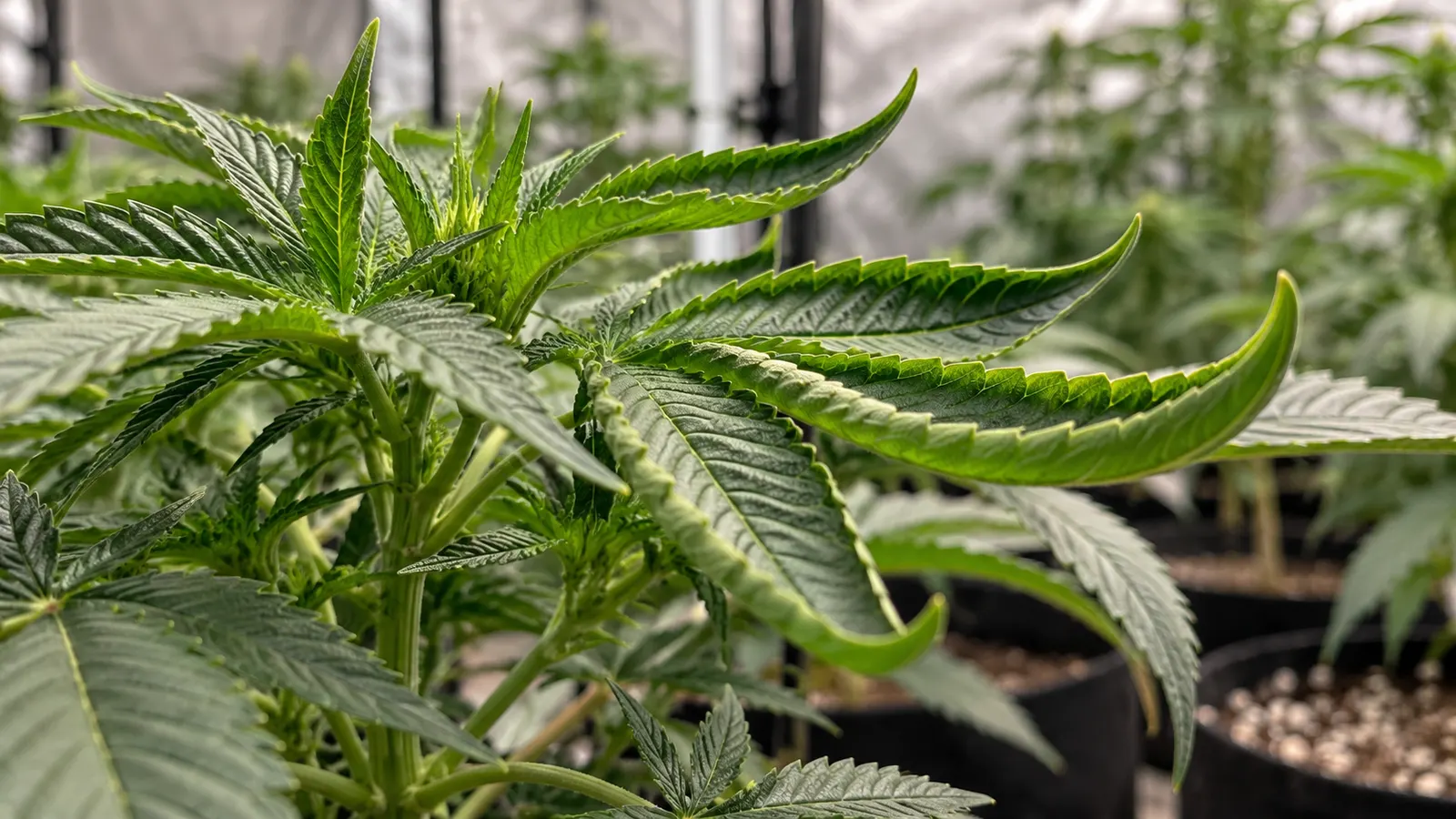
Leaves that fold upward along the midrib, edges pointing to the ceiling, are a plant trying to cut its water loss or its exposure. Purdue Extension, writing about corn, explains leaf rolling as a drought-stress response in which the plant closes its stomata to limit moisture loss. The principle carries over to cannabis: heat, dry air and a light that is too close all push the plant in that direction. A grow-equipment guide on heat stress says leaves may curl up or down or fold inward, so the direction alone does not prove the cause.
Practical steps:
- If the curl is worst at the top of the plant, closest to the lamp, raise the light or dim it. Our article on light burn and heat stress covers distances and temperatures.
- If the whole plant is tacoing and the room is hot and dry, fix the room first.
- If the leaves are curling up and also show rusty edges or spots, think magnesium or potassium. Utah State lists upward curling in both cases.
One check that costs nothing is to look again at different times of day. A plant that is flat at the start of the light period and curled by the afternoon is probably reacting to heat or light; one that stays curled around the clock deserves a look at the roots. This is a rule of thumb, not a test.
Leaves curling down (the claw)
Tips that bend downward like claws are the sign most often tied to overfeeding. Growlink states that overfeeding can also cause leaf curling and, unlike heat stress, typically does not leave the leaves looking burned. We know of no controlled trial that ties clawing to one specific nutrient, so treat the link as grower experience, not settled science. What we can say is that feed and water are the more common culprits when a plant looks unhappy.
If the leaves are clawing and the plant has been fed on a strong schedule, stop feeding for a watering or two and give plain, pH-adjusted water. Then go back to a lighter dose. If the claw starts after a long stretch of overwatering, the roots are the problem and the feed is secondary.
A rarer cause is a micronutrient shortage that distorts new growth. In the NC State trial, boron-starved plants produced new leaves that were severely distorted, curling inward and downward and at odd angles from the petiole. That was in plants given no boron at all, which is not a situation most growers end up in.
Drooping leaves
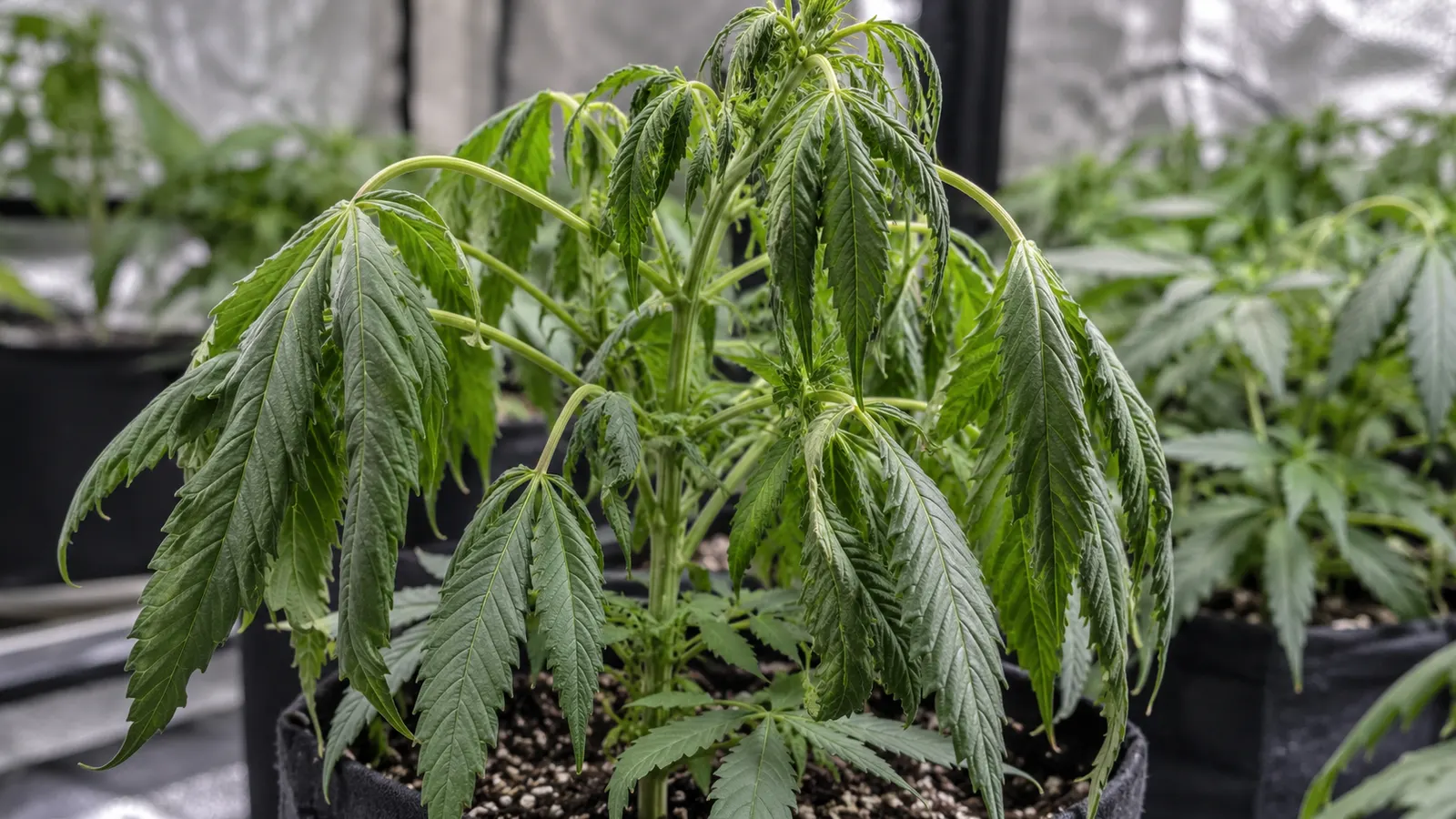
Drooping is the symptom where overwatering and underwatering look most alike. Both leave the plant unable to hold its leaves up. The difference is in the pot.
- Too dry: the pot is light, the medium is dry well below the surface, and the plant perks up soon after a drink.
- Too wet: the pot is heavy, the surface may be green or smell sour, and the leaves are limp, often with yellowing. Watering more will not help and will usually make it worse.
If a plant is drooping and the medium is soaked, leave it. Let the top few centimetres dry before the next watering and keep the room from getting cold. Smaller pots dry quicker, which is why a seedling in a huge pot is the easiest plant to overwater. If you see the stem base turn soft or the roots turn brown and slimy, the damage has gone further, and the root rot article covers what to do then.
Drooping right after transplanting or a big temperature swing is usually short-lived. Give it a day before you start changing things.
Spots on the leaves
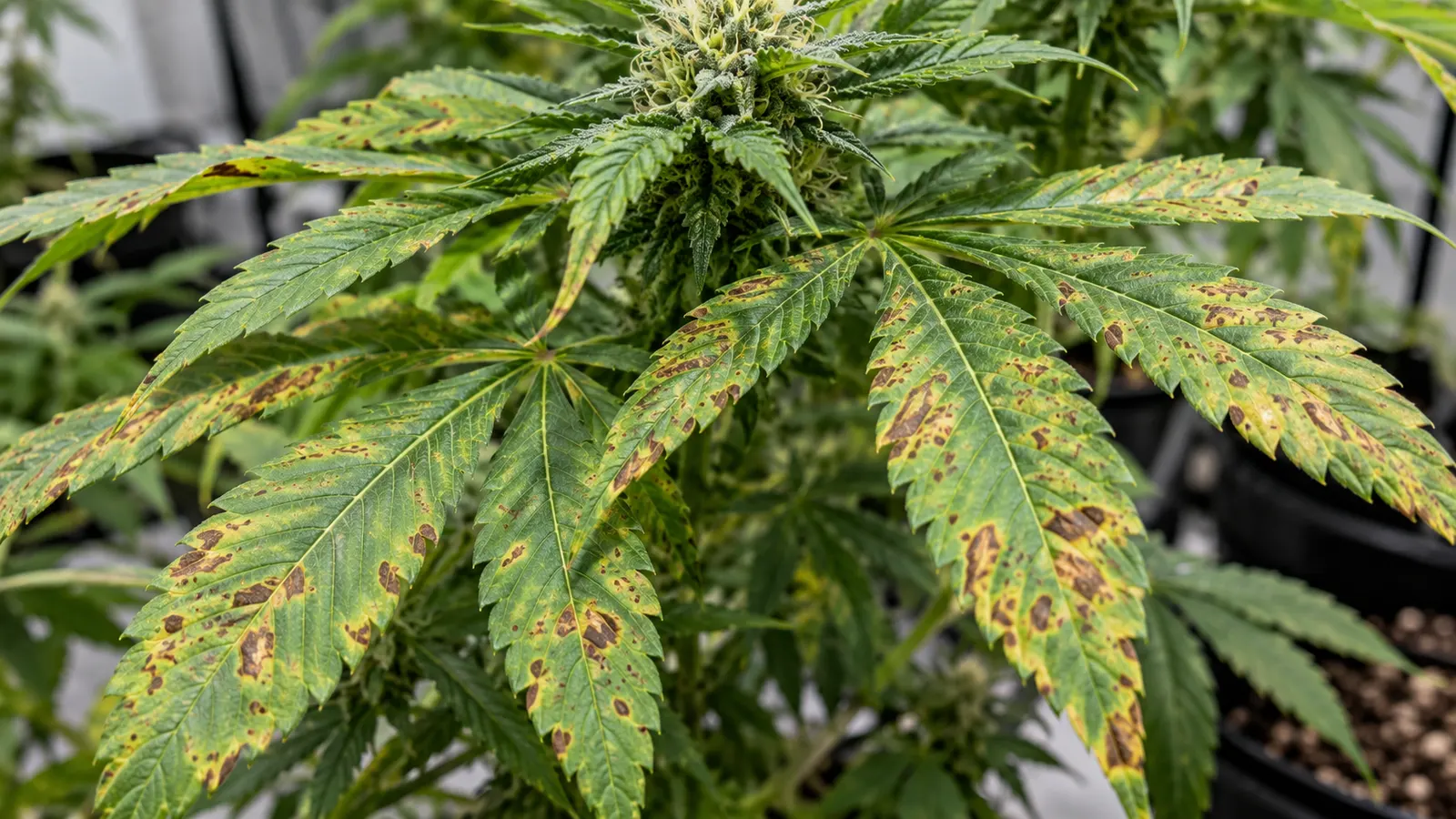
Spots are the hardest symptom to diagnose from a description, because several different causes produce brown or yellow marks. Work from the pattern.
Rust-coloured spots
Scattered rusty-brown spots on the leaf surface and edges are listed by Utah State under magnesium (irregular rust-brown spots on margins, tips and between veins) and potassium (rust-coloured blotches that turn brown). The NC State trial adds phosphorus, which gave a different picture: olive-green spots on the lower, older leaves that became sunken and almost wet-looking before drying out. Each of these tends to start on older leaves and get worse upward. Our guides on phosphorus and magnesium show how to tell them apart.
Damage on new growth: twisted or stunted tips
Calcium is the one people reach for, and it is often wrongly diagnosed. In the NC State trial, calcium shortage hit the growing tips and newly expanding leaves, which came out stunted, irregular and with dead margins. Cornell's nutrient resource gives the reason: calcium does not move within the plant, so the new leaves show symptoms first. Utah State's hemp page places calcium symptoms on the lower leaves, so sources disagree here, and spots alone are not enough to call it. If you suspect calcium, check pH first: a root zone out of range is a far more common reason that calcium does not arrive than a lack of it. Details are in the calcium deficiency article.
Small pale dots and fine webbing
Tiny yellow or white specks, especially on the underside of leaves, can be spider mites. Utah State describes the damage on hemp as leaves becoming stippled with small yellow spots and turning bronze as the infestation grows, with webbing showing up when populations are heavy. To confirm, look at the leaf underside with a hand lens, or shake a branch over a sheet of white paper and watch for specks that move. Utah State also notes that populations can increase rapidly in hot, dry conditions. Nutrient spots follow a pattern across the plant; mite spots are scattered and often worse on the undersides. Read our spider mite guide as soon as you see webbing.
Blisters and bumps
Raised blisters on the underside of the leaf that later turn tan or corky are not a pest. The trade article on overwatering explains this as edema: roots take up water faster than the plant can use it, pressure builds, and cells burst. It is another sign of too much water, or of wet roots in a humid room.
Brown, crispy edges and burnt tips
Brown edges and burnt tips on a plant that has been fed hard are usually salt damage from too much feed. The University of Missouri lists excess of any nutrient, which can be toxic to plants, with salt burn showing as marginal browning. Scorching only on the top leaves, with the bottom of the plant fine, is more often a light or heat problem than a feeding one. Compare the two before you decide.
Why more feed is rarely the answer
The reflex when leaves go yellow is to add something. Sometimes it is right, and a true nitrogen shortage in a plant that has been underfed will turn around with a normal dose. But the odds favour a water or feed problem, and in that case extra nutrients push the wrong way: more salt in the medium, a higher EC at the roots, and one more thing for a stressed plant to cope with.
A sequence that works:
- Check the pot weight and the medium. Fix watering first.
- Check the pH of the input water and of the runoff.
- Look at the pattern: old leaves or new, edges or between veins, one branch or the whole plant.
- Look at the undersides of the leaves with a magnifier.
- Only then change the feed, and change one thing at a time so you can see what worked.
Give a plant a week to show the result of any change. New growth is where you will see it, since leaves that are already damaged usually do not recover. A yellow leaf stays yellow; what matters is that the next leaf comes in healthy.
For a broader look at what healthy leaves look like and how to read them across the grow, see checking leaves to see how your plant is doing, fan leaves, sugar leaves and leaf problems and the ultimate guide to cannabis leaves. If you are working out what to feed and when, which nutrients cannabis needs and when is the next stop.