Harvest to Jar: When to Harvest, Dry, Trim and Cure Cannabis
Harvest when most of the trichomes and pistils have turned from white towards red or brown, and not before. Then dry the buds slowly in a dark, airy room until the small stems snap, trim them, and cure a portion in airtight jars somewhere cool and dark. The step people rush is the one that costs them: buds that go into a jar too wet can grow mould, and mould can spread until the whole harvest has to go in the bin.
Below we go through each stage, from the last weeks of flowering to the jar on the shelf. Where something is backed by research we link the study. Where it is our own experience at Amsterdam Marijuana Seeds, we say so.
When to harvest cannabis
There is no single date that works for every plant. A seed packet gives a flowering time, but that is a range for the strain, not a promise for your plant in your room or garden. The plant itself tells you when it is ready, and the clearest signs are the trichomes and the pistils.
Reading the trichomes
Trichomes are the tiny resin glands that cover the buds and the small leaves around them. You need a jeweller's loupe or a cheap pocket microscope to see them properly.
Researchers at Simon Fraser University in Canada followed trichomes on two strains under the microscope from week 3 to week 8 of flowering. As the glandular heads matured they turned brown, and because trichomes form at different times, one bract carried trichomes at different stages of maturity side by side. Genotype and plant age both changed how many trichomes formed and how they developed (Punja et al., 2023). In plain terms: you will never see one uniform colour, and two strains in the same tent will not ripen the same way. If you want to know why some strains carry so much more resin than others, our piece on strains with the most trichomes goes into that, and kief and trichomes covers what you can do with the resin that falls off.
What we advise: watch the pistils, the little hairs, turn from white to red and brown, and look at the trichomes with a loupe as they go from clear to cloudy. In our experience, when roughly half or a bit more has turned red and brown, the smoke is often sweeter and softer. Some strains are better taken early on purpose. With Amnesia, for example, we find it should still be fairly green and white when you cut it to get the taste and feel it is known for. That is our own experience with these plants, not a lab result, and your preference may differ.
Feminized cannabis seeds from the same line tend to ripen within a similar window. If you want to keep your own mothers or make your own crosses, you need males too, so start from regular cannabis seeds.
Pistils and the calendar, and why they can mislead
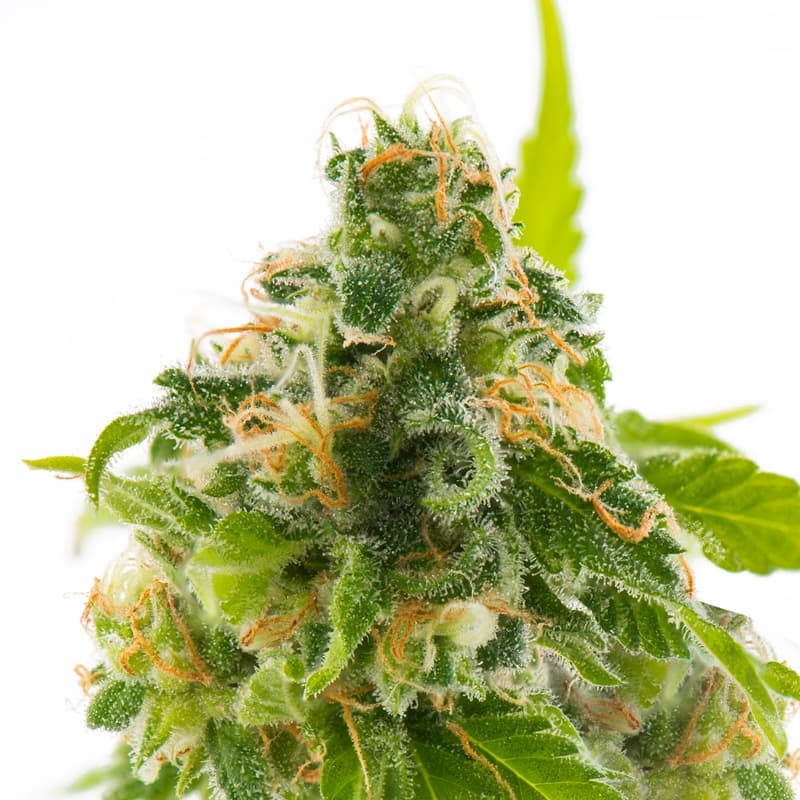
Pistils are the little hairs on the buds. They start white and turn orange, red or brown as the flower matures. They are easy to see without a loupe, which makes them a good first signal. They are a rougher signal than the trichomes, so look at both. A strain like Skunk Red Hair, an easy indica-dominant plant with a flowering time of 6 to 10 weeks on its product page, shows why a range like that is only a starting point: check the plant, not the calendar.
Use the calendar to know when to start looking closely. Use the trichomes and pistils to decide.
Autoflower versus photoperiod harvest timing
Photoperiod plants flower when the nights get long enough: indoors when you switch the light schedule, outdoors as autumn comes. You can hold them a few days longer if the buds are not ready. Autoflower seeds work differently. The plant switches to flowering by age, so the whole cycle from seed to harvest is short and fixed. The product page for Big Bud Autoflower says most plants are ready to harvest by 9 weeks from germination. The same rule applies here: the plant decides, not the week number.
Outdoor harvest and the weather
Outdoors you are working against the season as well as the plant. Humidity around the buds is one of the things that raises mould levels (more on that in the drying section), so a long wet spell in autumn is a real risk for dense buds. If the forecast turns and your trichomes are close, it is often better to cut a few days early than to lose buds to mould. Growers with a short or cold season usually do better with outdoor cannabis seeds that finish early, and we keep a separate list of seeds for cold climates. A sativa-dominant plant such as MOAB, which lists a flowering time of 8 to 12 weeks, needs a long, warm autumn to finish outside.
The last days before harvest: flushing and darkness
Flushing means giving the plant only plain water for the last period before harvest, so it stops getting fertiliser. We recommend it strongly. In our experience buds from plants that were not flushed can taste of fertiliser in the smoke, and that is not pleasant. That is our own experience when we smoke the result, and it is the reason we flush.
The research is thin, though. A 2024 study by Saloner and colleagues in the journal Industrial Crops and Products compared flushed and unflushed plants of five medical cultivars. Flushing had a limited effect on cannabinoids, terpenes, minerals and yield, and the small effects they did see leaned more towards positive than negative. That study did not test taste. So the taste benefit is our experience, not something research has proven. Our article on flushing weed plants covers how to do it.
Some growers also put plants in total darkness for a day or two before cutting, sometimes called shocking the plant. We have not found a controlled study we could read on this, so we make no promise about what it does. It does not replace picking the right moment.
Harvesting step by step
- Get the drying space ready before you cut: dark, with air moving gently and no fan blowing straight on the buds.
- Wear gloves and use clean, sharp scissors or pruners. Resin builds up on the blades quickly, so keep a cloth and some alcohol nearby to clean them.
- Cut whole branches, or the whole plant, so you have stems to hang.
- Remove the big fan leaves straight away. Whether you also trim the small leaves now or later is the wet trim versus dry trim choice below.
- Check every bud as you go. Grey fluff, brown mushy spots or a musty smell inside a bud mean that part goes in the bin, not on the drying line.
The harvesting chapter of our grow guide has more on the cutting itself.
Drying
Go slowly with drying. In our experience, buds that dry too fast lose smell and taste and smoke harsh. Buds that stay wet too long can grow mould.
A large study of commercially grown cannabis gives a useful picture of what keeps mould down after harvest. Over three years and more than 2,000 samples, the factors that lowered yeast and mould counts included hang-drying whole stems and drying buds to a moisture content of 12-14% (a water activity of 0.65-0.7) or lower. Inadequate drying and higher temperature and humidity around the buds pushed the counts up (Punja et al., 2023). Home growers rarely own a moisture meter, but the message is simple: hang whole branches, keep air moving, and make sure the buds are really dry before they go further.
Another study compared drying methods on two cultivars and found that the best conditions for keeping terpenes and cannabinoids were different for each one. It also found that buds dried the traditional way picked up more mould than those dried in controlled chambers (Birenboim et al., 2024). Those chambers are commercial equipment, but the lesson carries over: there is no single perfect recipe, and a clean, controlled room beats a damp shed.
How do you know drying is done? Bend a small stem. If it bends and stays flexible, wait. If it snaps, the buds are ready to trim or go into jars. The outside of a bud can feel dry while the inside is still wet, so check a few of the thickest ones, not just the small ones.
Trimming
Trimming means cutting away the small leaves around the buds. You can do it wet, straight after harvest, or dry, once the buds have hung.
- In our experience, wet trimming is easier because the leaves stand out and the buds are firm. The buds also dry a bit faster, which helps in a humid room.
- Dry trimming is slower and stickier in our experience, but the leaves shield the buds while they dry, which helps in a dry room where buds risk drying too fast.
Research on one medical hybrid found a trade-off: a mild trim before drying gave the highest cannabinoid levels, while trimming after drying kept the most terpenes, the compounds behind smell and taste (Brikenstein et al., 2024). That is one cultivar, so treat it as a hint rather than a rule. At home, pick the method that suits your drying room.
Do not throw the trim away. The small sugar leaves carry resin and can be used for butter, hash or kief, and our list of ways to use leftover weed has more ideas. For cutting back living plants during the grow, see the pruning chapter of the grow guide.
Curing
Curing comes after drying. Most people want to smoke as soon as the buds are dry, and that is fine. What we advise is this: if you have enough, set a portion aside and cure it for as long as your patience allows. Keep it cool and dark in airtight containers. Some growers use vacuum jars or keep the jars in the fridge, and freezing is also used.
Fill jars loosely, not packed tight, and open them regularly at the start to let moist air out. If the buds feel damp again after a day in the jar, they were not dry enough. Take them out and let them hang longer. A musty smell means stop and check every bud.
How long should you cure weed? That is a matter of taste. We wrote a separate, detailed guide on how long it takes to cure weed, with what changes along the way and when it is ready to smoke.
Storing your harvest
Once cured, the enemies are light, heat, air and moisture. Dark glass or a dark cupboard, a cool spot and an airtight lid do most of the work.
In one study of high-THC buds stored for four months, THCA dropped by 4-23% depending on treatment. The smallest loss was in vacuum-stored buds whose plants had also been sprayed before harvest, and the lighter terpenes broke down faster than the heavier ones (Birenboim et al., 2024). In practice that means smell fades first, and keeping air away from your buds slows the loss.
Does weed go off? It loses smell and taste over time and can go mouldy if moisture gets in. Our article on whether weed expires covers shelf life in more detail.
Mould, and what to do when something smells wrong
Mould is why the steps above matter. The commercial study mentioned earlier found that strains with dense buds and many small leaves, high humidity around the buds, and poor drying all raised mould counts, while air circulation from fans and proper drying lowered them (Punja et al., 2023). A review of fungi on cannabis and hemp flowers counts over 100 species of fungi that have been found living on these plants (Gwinn et al., 2023).
What to look for:
- Grey or white fluff on or inside a bud.
- Brown, soft spots that crumble, often deep in the densest buds.
- A musty, damp or cellar-like smell from a jar.
Our rule is simple: do not smoke buds that are mouldy or smell mouldy. Cut out an affected bud with a margin around it, and check the rest of the jar or the line. Mould spreads, and missing one bad bud can cost you the batch. The mildew, pests and diseases chapter of the grow guide covers prevention during the grow.
Mistakes we see most
The one we see most is going too fast. People cut too early because they are impatient, dry too quickly with heat or a fan pointed at the buds, and jar buds that are only dry on the outside.
The second is missing mould. One mouldy bud on the line or in a jar is easy to overlook, and it can spread until everything is mouldy. Then the whole batch is lost. Check while you harvest, check while it dries, and check again in the jar.
A smaller one: skipping the flush. In our experience that is when people notice a fertiliser taste in the smoke.
Which seeds make harvest easier?
If this is your first harvest, a short, predictable plant takes a lot of the guesswork away. Autoflowers finish on their own schedule, and a feminized indica-dominant strain like Chronic, rated easy to moderate on its product page, is a forgiving place to start. Its page also notes that drying the buds thoroughly helps keep the aroma.
Flowering time differs by type, and our own product pages show it: Chronic, which is mostly indica, lists 6 to 10 weeks, while MOAB lists 8 to 12. Browse indica seeds or sativa seeds with your season in mind. If you grow outdoors and your autumn turns wet early, a shorter flowering time gives you more room to harvest before the rain, so check the flowering time listed for each indica or sativa strain before you buy. You can also browse our full range of marijuana seeds.