Indica vs Sativa: Differences, Effects and Growing
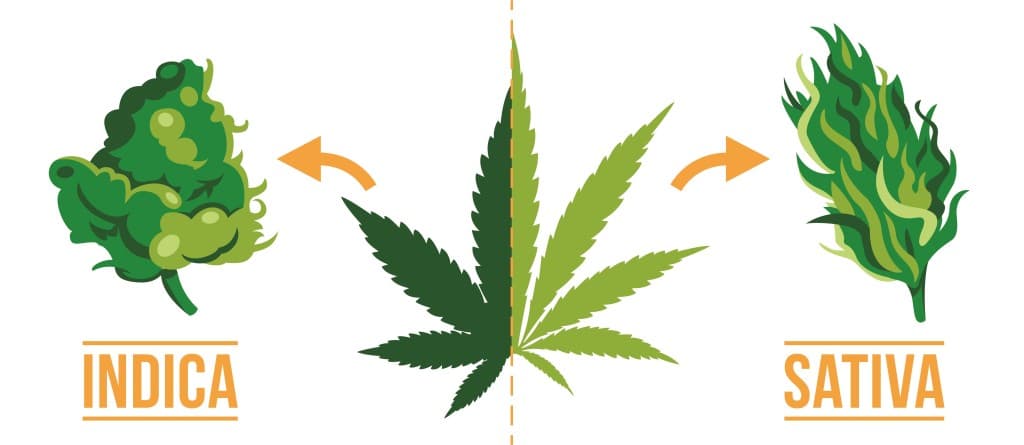
Indica and sativa (Cannabis indica and Cannabis sativa) are two ends of a spectrum, not two boxes. Indica-type plants are short, bushy and broad-leaved. Sativa-type plants are tall, lanky and narrow-leaved. Shop labels add a second claim: indica relaxes, sativa energises. That second claim is the shaky one. Published research finds the labels only loosely follow the chemistry and genetics of the plant, so the cannabinoid and terpene profile tells you more about a strain than the word on the jar.
This guide covers the difference between indica and sativa in the order most people ask about it: how to tell the plants apart (including the leaf), what the effects really depend on, where each type comes from, how they grow differently, and why most strains today sit somewhere in between.
The short answer: indica vs sativa at a glance
If you only need the headline, this is the traditional split:
- Indica strains: short, bushy plants with broad, dark green leaves. They are linked with a heavy, relaxing body feel and are usually kept for the evening.
- Sativa strains: tall, slim plants with narrow, light green leaves. They are linked with an uplifting, head-first effect and are usually kept for the day.
- Hybrids: crosses of the two, and the bulk of what is sold today. They are labelled indica-dominant, sativa-dominant or balanced.
The plant description holds up well. The effect description is a tendency at best. A so-called sativa can make one person drowsy, and an indica can leave another wide awake. The sections below explain why.
How to tell the difference between indica and sativa plants
Looking at the plant is the one place where the old indica and sativa split still works, especially for growers who see the plant for months rather than a bag of dried flower for a minute.
Indica appearance
- Short and bushy, with tight spacing between branches.
- Broad, dark green leaves with wide, overlapping leaflets.
- Dense, heavy, resinous buds that cluster close to the stem.
- A compact shape that suits indoor tents and small spaces.
Sativa appearance
- Tall and slender, with long gaps between branches and an open, airy frame.
- Thin, pointed, lighter green leaves with narrow leaflets.
- Longer, looser, fluffier buds that form in spaced clusters.
- A shape that likes headroom, which is why it does well in a greenhouse or outdoors.
Indica vs sativa leaf: the quick check
The leaf is the first thing people look at, and it works as a rough guide. Fat, wide leaflets point toward indica. Long, thin, finger-like leaflets point toward sativa. Two cautions. Hybrids carry a mix of both leaf types, so a medium-width leaf usually means a cross. And leaf shape says nothing about how a strain will feel: it describes the plant, not the effect.
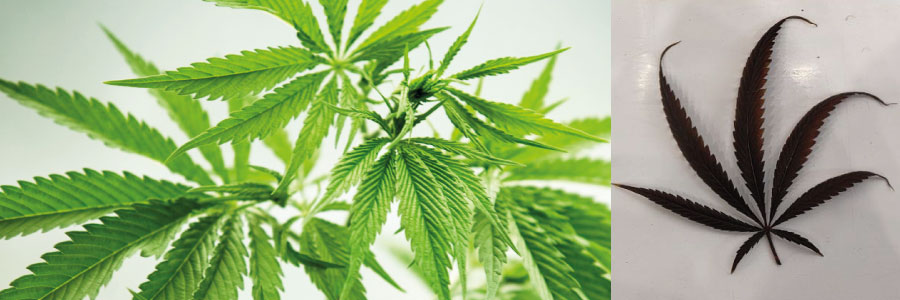
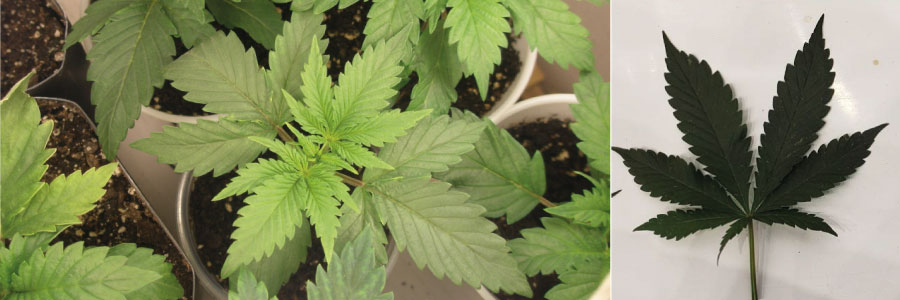
Structure differs below ground too. Sativa-type plants tend to send down a deeper taproot, which helps in dry outdoor conditions. Indica-type plants tend to spread a shallower, wider root system. These morphological differences shape how, where and why each type is grown.
Where indica and sativa come from
The two types are named after the places they adapted to, and that history explains most of the shape differences above.
Sativa origins
Sativa-type plants come from equatorial regions such as Thailand, Jamaica, Colombia and Mexico: long sunny days, high humidity and steady temperatures all year. There, a tall, slender plant with narrow leaves wins. It competes for light in dense foliage, and the narrow leaves and open branching shed moisture and discourage mould. A longer flowering cycle fits the steady day length of those regions.
Indica origins
Indica-type plants come from the Hindu Kush range, which runs through Afghanistan, Pakistan and parts of northern India and China. Cold nights, wind, rocky ground, poor soil and a short season favour a plant that stays low, grows broad leaves to catch light, packs its buds tightly and finishes flowering quickly.
Understanding the home climate helps you pick a strain for yours: sativa-leaning plants want a long, warm season, while indica-leaning plants cope better with cooler weather and shorter summers.
Indica vs sativa effects: what the research says
The popular version is simple: indica is the couch relaxer and sativa the daytime energiser. Many people do report that pattern, and expectation plays a part: if you expect a strain to relax you, you are more likely to notice it.
The lab data does not back the neat split, though. In a study of commercial cannabis samples across six US states, Smith et al. (2022) found distinct chemical profiles (chemotypes) that show up reliably, but the commercial labels did not consistently line up with them. Some labels were biased toward certain chemotypes, others were not. A genetic study by Watts et al. (2021) compared over 100 samples and found that sativa-labelled and indica-labelled cannabis were genetically indistinct across the genome. What did differ with the label was a small set of terpenes controlled by terpene synthase genes.
In plain terms: not every sativa energises you and not every indica sedates you. The label is a rough hint about aroma and chemistry, not a promise about effect.
What actually shapes the experience
- The chemical profile of the strain: the THC to CBD balance, minor cannabinoids and terpenes.
- Dose. A strong strain in a small amount can feel different from the same strain in a large one.
- How you consume it: smoking, vaping and edibles act on different timelines.
- Your own tolerance, body chemistry and mood going in.
If you are new, start low and go slow, whatever the label says. Cannabis affects people differently, and for any health question, speak to a doctor rather than a seed catalogue.
Cannabinoids: THC and CBD
THC is the main intoxicating compound and also drives appetite. CBD is not intoxicating and tends to soften the edge of THC. Rather than starting from “indica or sativa”, it helps to start from which of these three groups you want:
- THC-dominant strains: for people who want a strong, euphoric effect. If you dislike what THC does to you, skip these.
- Balanced THC and CBD strains: a gentler profile and a common starting point for newcomers.
- CBD-dominant strains: CBD-dominant strains contain little THC, so they suit people who are sensitive to THC. Harlequin is the name most often given as a CBD-rich example.
Strength is not quality. A very high-THC strain is not automatically the better experience; some people enjoy a fragrant, moderate strain or a balanced one far more. If THC tends to make you feel jittery or racy, a lower-THC, higher-CBD choice is worth trying first.
Terpenes
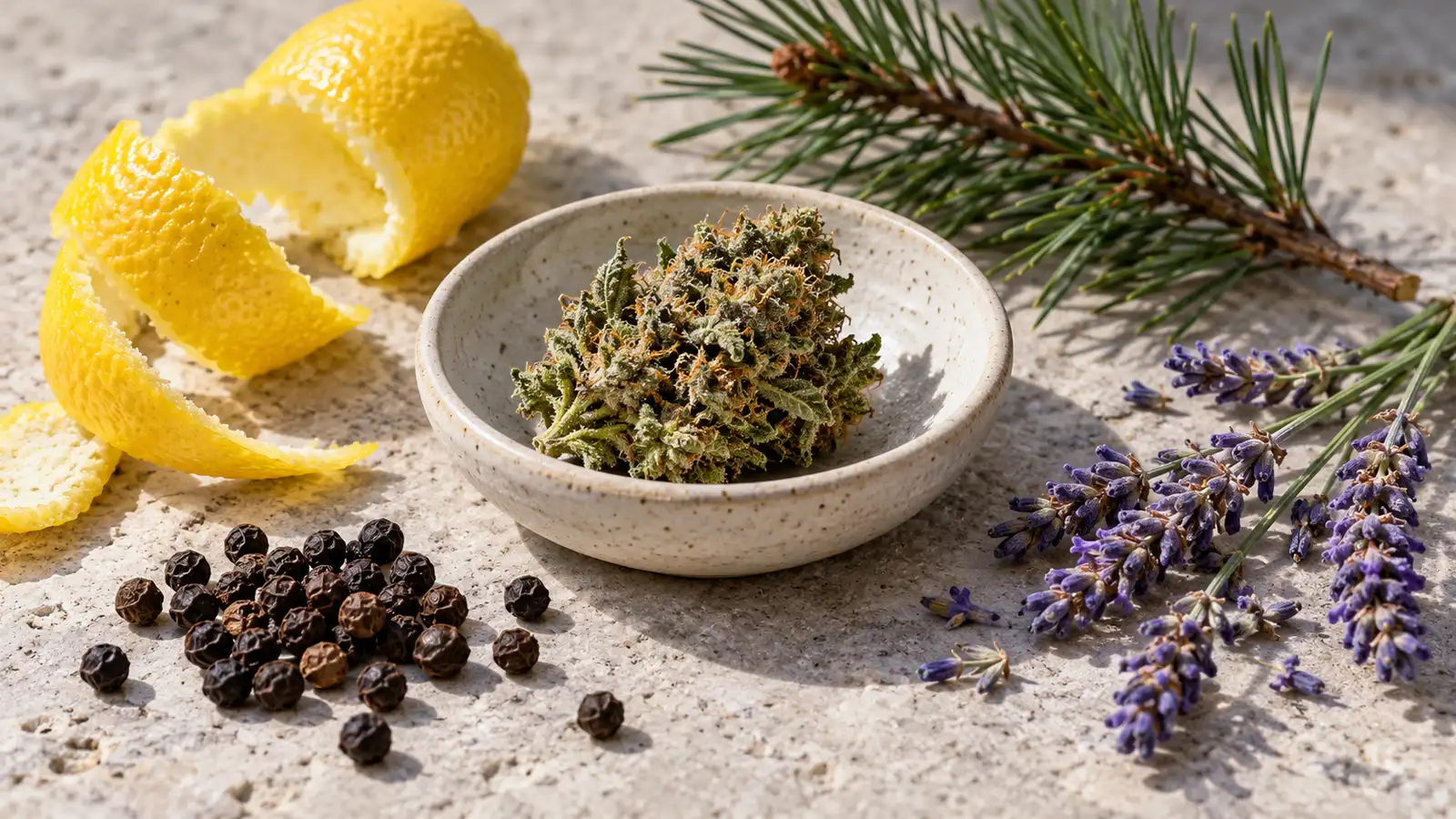
Terpenes are the aroma compounds that make cannabis smell of pine, citrus, berries or spice. They are not unique to cannabis: oranges, pepper, hops and lavender make them too. Terpenes are the same kind of compounds you smell in a citrus peel or a pine forest. For the full background, see our guide to cannabis and terpenes.
The terpenes you will see named most often are myrcene, limonene, pinene, terpinolene, linalool and caryophyllene. Sativa-labelled strains are often described with limonene, pinene and terpinolene, indica-labelled strains with myrcene, linalool and caryophyllene. Treat that as a pattern in how strains are described, not a rule. Because the mix differs strain by strain, you may find you gravitate toward strains with a similar terpene profile. Finding your own match often takes some trial and error.
Indica vs sativa: growing differences
For a grower the difference between indica and sativa is practical, and here the labels are more useful than they are for effects. We checked our own seeds table to see how far the textbook picture holds for strains we actually list.
- Of the 151 listings that show an indica/sativa ratio, 96 lean at least 60% indica and 50 lean at least 60% sativa. The other 5 are balanced or close to it (50/50 or 45/55).
- Flowering time follows the type, loosely. 5 of the 50 sativa-leaning listings are rated long (10-16 weeks), and none of the 96 indica-leaning ones are.
- Of the sativa-leaning listings, 13 are rated fast (6-10 weeks), 31 average (8-12 weeks) and 5 long, and 1 has no rating. Of the indica-leaning listings, 30 are rated fast and 64 average, and 2 have no rating. The bands overlap in weeks because the table rates them by label.
- The typical indoor height listed is about 80 cm for indica-leaning listings and about 100 cm for sativa-leaning ones (medians, from the 94 indica-leaning and 50 sativa-leaning listings with a height), although both groups include much taller outliers.
So the textbook picture is right on average and wrong for plenty of individual strains. Breeding has blurred the edges. Check the numbers on the product page of the strain you plan to grow instead of relying on the type.
A real pair from the catalogue shows it. Northern Lights XTRM is listed as 70% indica and 30% sativa, with an indoor height of up to 80 cm and a flowering time of 8-12 weeks. Super Silver Haze is listed as 35% indica and 65% sativa, also with an indoor height of up to 80 cm and 8-12 weeks. Different ancestry, similar grow profile on paper.
Indoor growing
Indica-leaning plants stay compact and have a high bud-to-leaf ratio, which is why they are the usual first pick for a tent. A shorter vegetative phase also means a faster turnaround. Sativa-leaning plants can stretch hard in flower, so check your ceiling height and plan to train them. Low-stress training and topping help keep a tall plant in a tent.
Outdoor growing
Sativa-leaning plants use a long, warm season well and are less prone to mould thanks to their open structure. Indica-leaning plants finish earlier, which matters in cooler climates or where autumn rain arrives early. If you are new to growing, autoflowering seeds sidestep the question of day length altogether.
A tip for growers: choose indica-leaning genetics for compact indoor setups and sativa-leaning genetics for spacious gardens or greenhouses. Hybrids give you room to pick a middle path.
Hybrids: where most strains sit
Most modern cannabis is a hybrid, a cross of indica and sativa lines. Hybrids are usually labelled indica-dominant (leaning relaxing), sativa-dominant (leaning energising) or balanced. A hybrid can combine, for example, a calm body feel with a clear head, or a quick finish with a taller frame. Classic indica-leaning names include Northern Lights, Afghan Kush and Granddaddy Purple. Sour Diesel, Jack Herer and Super Silver Haze are the usual sativa-leaning examples. Blue Dream, Gelato and Girl Scout Cookies are well-known hybrids.
If you are new to cannabis or not sure what you want, a hybrid with a clear description is a sensible starting point, and our hybrid seeds are listed by type.
Samankaltaiset siemenet
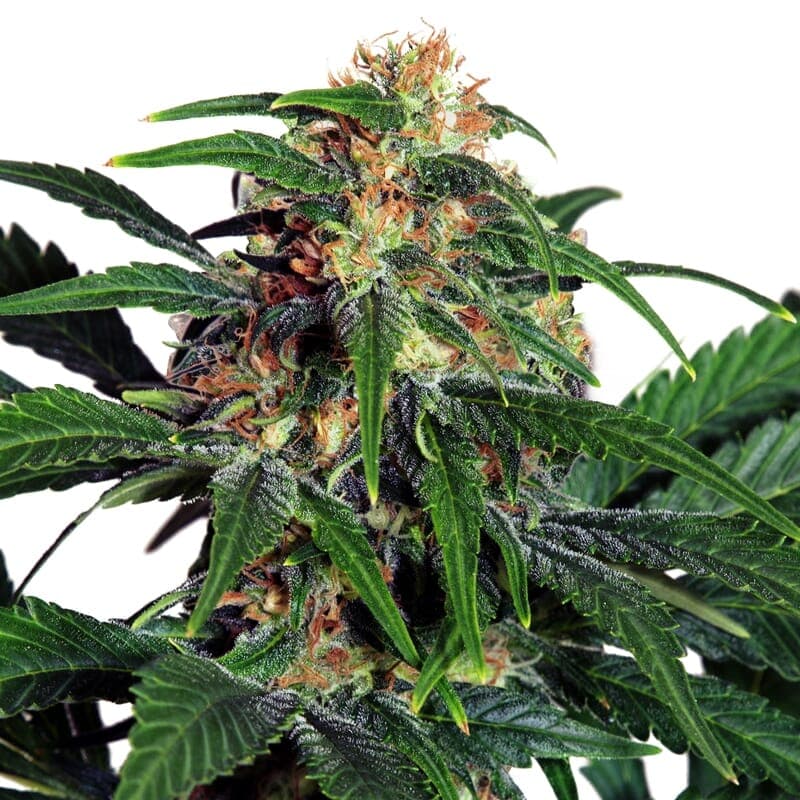
Which should you choose, indica or sativa?
Which one is better depends on what you want from it. Most people use the types like this, as a starting point and not as a guarantee:
- Indica-leaning: for a calm evening and a heavier body feel. Many people save them for night-time.
- Sativa-leaning: for a lighter, head-first feel that people often link with creativity, focus and sociable settings, mostly in the daytime.
- Hybrid: for something in between, or when you want a particular trait such as a short flowering time.
- Anything, if the profile fits: look at THC and CBD levels and the terpene profile of the strain, not only the label.
Do you feel more high on sativa or indica? Neither reliably. Strength comes from the THC level, the dose and how you take it. Does indica make you sleepy? Often it is described that way, and some indica-labelled strains do, but sleepiness follows the strain's chemistry and the dose rather than the word indica. Legal rules differ by country, so follow the laws where you live.
Explore seeds by type
Once you know which side of the spectrum you want, you can browse by it:
- Looking to relax and unwind? Browse our indica cannabis seeds.
- Want a more energising daytime profile? See our sativa cannabis seeds.
- Want a bit of both? Try our hybrid cannabis seeds.
- New to growing? Our autoflowering cannabis seeds are the easy, fast option.
- Want plants that are guaranteed female? Choose feminized seeds.
- Want a low-THC profile? Check our high-CBD seeds.
Our seeds table lets you compare height, flowering time, yield and indica/sativa ratio side by side. You can also browse all marijuana seeds or the full seed catalogue, and Amsterdam Marijuana Seeds ships discreetly worldwide with a germination guarantee. If you need step-by-step help, our Grow Guide or our support team can help.
What to take away
Judge the plant by its shape and the strain by its numbers. Before you buy, read the listed height, flowering time and THC and CBD levels on the product page, and the terpene notes if there are any. If a strain disappoints, change the strain or the dose before you write off the whole type.
Check the video of this blog: