Boost Your Marijuana Yield with the Right Fertilizers
The right fertilizer for cannabis is the one that matches your growing medium and the stage the plant is in. In soil, a living mix with slow organic amendments usually needs the least attention. In coco or hydro, you feed a balanced bottled nutrient at a measured strength and keep the pH in range. Either way, the plant needs nitrogen, phosphorus, potassium, calcium and magnesium, and most feeding problems come from too much of one of them, not too little of all.
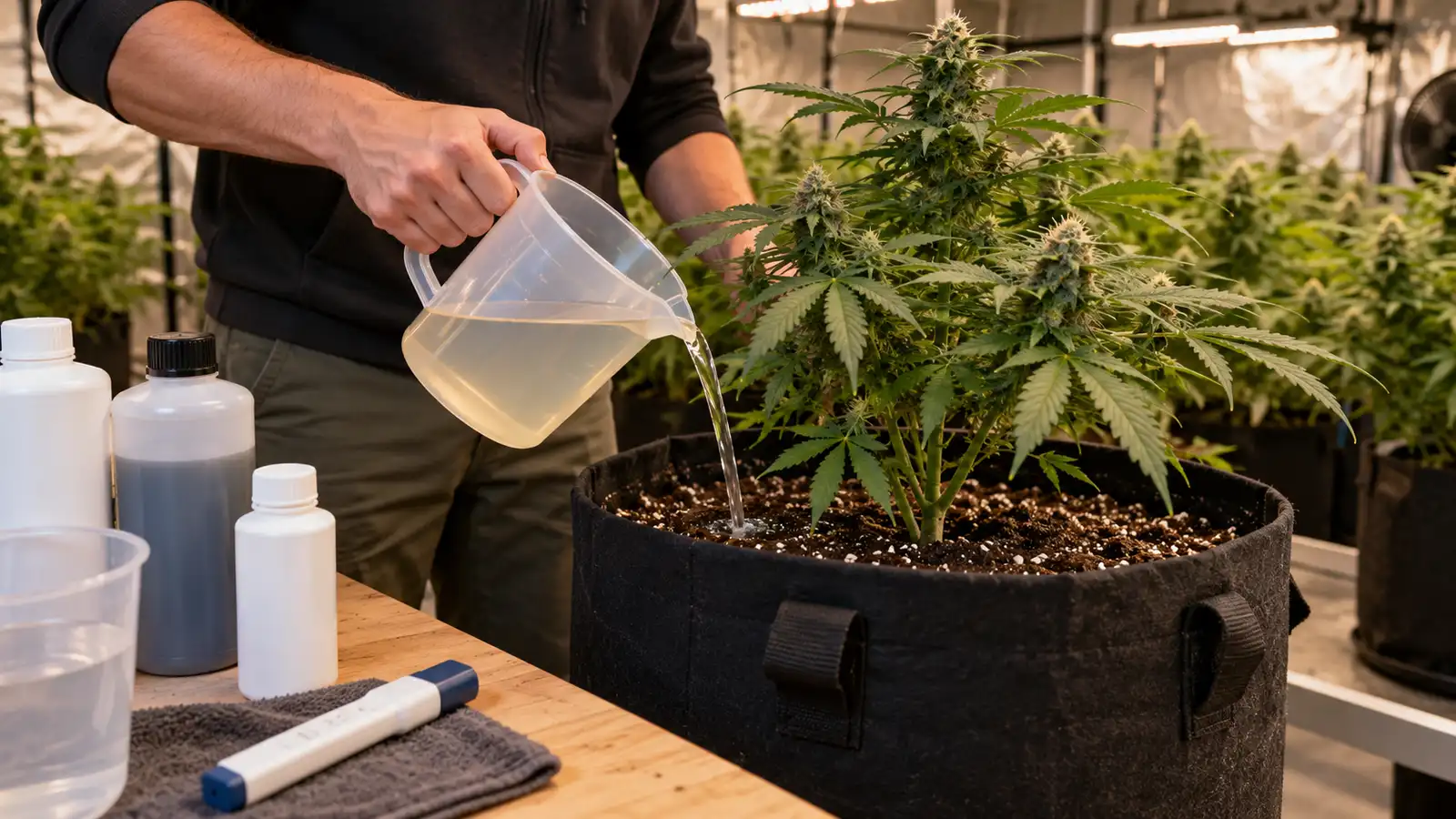
This guide covers what each nutrient does, how to read the leaves when something goes wrong, which organic options are worth using (and which ones are sold with the wrong job description), and how to feed without burning your plants. We see the same pattern again and again with new growers: the plant looks a bit pale, they add more food, the tips burn, and they add something else to fix that. Slowing down almost always helps more than adding.
Pre-mixed or organic: which type of fertilizer should you choose?
There are two broad routes, and neither is better in every situation.
Pre-mixed fertilizers come as bottled liquids or powders with a printed feeding chart. They are formulated to supply the full set of nutrients, they dissolve fast, and the plant can use them almost immediately. That makes them predictable, and it also makes mistakes quick: an overdose shows up inside days. They suit coco, hydro and any grow where you want tight control. They need a pH check, because the same bottle that works at the right pH can lock nutrients out when the water is off.
Organic fertilizers come from plant, animal or mineral sources such as guano, fish meal, worm castings and wood ash. Microbes in the soil have to break them down before the roots can take them up, so they act slowly and tolerate more. They suit soil grows, and they can be mixed into the potting soil before planting or used as a top dressing. The trade-off is that you can't rescue a hungry plant in two days with them, and some smell. If you want to go further down this road, our guide to growing cannabis organically covers the whole system, and the notes on compost tea show one way to deliver organic nutrients as a liquid.
Many growers mix the two: a living soil base, plus a light liquid feed in the middle of flowering when demand peaks. If you grow autoflowers, keep it light either way. They run a short life cycle and are quicker to show burn, which is one reason the soil conditions you start with matter so much.
What do cannabis plants need from a fertilizer?
Cannabis uses a long list of nutrients, but five of them cause most of the questions: nitrogen, phosphorus, potassium, calcium and magnesium. The first three are the NPK numbers on every fertilizer label. The other two are often missing from basic mixes and show up as problems in coco and in soft water.
One thing to know before the list: the nutrients do not work alone. A 2021 study in Frontiers in Plant Science tested nitrogen, phosphorus and potassium together on flowering cannabis and found that they interact, so the best amount of one depends on how much of the others the plant gets (Bevan, Jones and Zheng, 2021). In practice that is why chasing a single deficiency with a single product so often backfires.
Nitrogen (N)
Nitrogen builds proteins and chlorophyll, so it drives leaf and stem growth. It is the nutrient the plant wants most during the vegetative stage. The classic sign of too little is pale or yellow older leaves, because the plant moves nitrogen from old leaves to new ones. Too much gives very dark, glossy leaves that curl down at the tips and slows flowering. Research on vegetative medical cannabis in soilless culture found the healthiest plants at a middle nitrogen level and visible deficiency symptoms at a low one (Saloner and Bernstein, 2020). That was one setup with one set of genotypes, so treat it as a direction and not a dose.
Phosphorus (P)
Phosphorus supports roots and energy transfer, and demand rises when the plant starts to flower. Deficiency tends to show up as slow growth, dark or purple-tinged leaves and weak roots. Purple stems alone do not prove a deficiency, since some strains turn purple in cool nights, so look at the whole plant before you add anything.
Potassium (K)
Potassium regulates water movement and many enzyme reactions. A shortage usually appears as scorched, crispy leaf edges and tips on the older leaves, often during mid to late flowering. It is also commonly confused with salt burn. Our page on potassium deficiency shows how to tell the two apart.
Calcium (Ca)
Calcium builds cell walls and can't move around in the plant, so a shortage hits new growth first: twisted, spotted or stunted young leaves. It is a frequent issue in coco and with reverse osmosis water. See calcium deficiency for the signs in detail.
Magnesium (Mg)
Magnesium sits at the centre of the chlorophyll molecule. Unlike calcium, the plant can relocate it, so a deficiency shows on older leaves first as yellowing between the veins while the veins stay green. The magnesium deficiency guide has the full picture, including the common link with low pH and heavy potassium feeding.
Which factors decide the best marijuana fertilizer for your grow?
Before you buy a product, check these points in order. They explain most failed feeding schedules.
- Growing medium. Soil buffers mistakes and holds nutrients. Coco and hydro hold almost nothing, so you supply everything and every error counts.
- pH of the water and the root zone. The plant can only take up a nutrient inside a certain pH window. Many growers aim for roughly 6.0 to 7.0 in soil and 5.5 to 6.5 in coco or hydro. Outside that, nutrients are present but locked. Read our pH guide and, if leaves are going yellow despite regular feeding, the page on nutrient lockout.
- Aeration and moisture. Roots need oxygen to absorb anything. Waterlogged soil blocks uptake, whatever you feed.
- Stage of growth. Seedlings need very little. Vegetative plants want more nitrogen. Flowering plants shift toward phosphorus and potassium.
- Raw materials. Look for a clear ingredient list. A fertilizer that does not tell you what is in it is a guess you pay for.
- Strain and plant type. Heavy feeders and light feeders exist. Autoflowers usually do better on a lighter plan than photoperiod plants of the same size.
When you are unsure, start at half of the strength printed on the label and work up only if the new growth stays healthy for a week or two. Underfeeding corrects itself in a few days. Overfeeding can take weeks to grow out.
Which eco-friendly fertilizers work, and which claims are wrong?
The older version of this post listed several natural products and gave them credit they do not deserve. Here is the corrected list, with what each one is actually good for.
Bat guano
Bat droppings have long been used as an organic fertilizer. Fresh, nitrogen-rich guano suits the vegetative stage, and products sold for bloom are usually richer in phosphorus. The mix varies by source, so read the analysis on the bag. Guano can be worked into the soil before planting, or steeped for a liquid feed. It is strong, so a small amount goes a long way.
Wood ash
Wood ash contains potassium, calcium and magnesium, but it also acts as a liming agent and raises the pH of the soil. Oregon State University Extension recommends it mainly for acidic soils that are low in potassium, advises against using it when the soil pH is already 7.0 or higher, and warns that too much can push the pH to a level that harms plants. It also says ash from coal, treated wood or burned trash is not safe to use (Oregon State Extension). If you use it at all, use ash from plain untreated wood, dust it on very lightly, and test the pH afterwards. For most container grows with a bought potting mix, we would skip it.
Fish meal
Fish meal is made from ground fish by-products and gives slow-release nitrogen and phosphorus. Mixed into the soil, it breaks down over weeks as microbes work on it. It does not make seeds germinate better, so do not use it at the seed stage, and it can smell and attract animals when used outdoors. Fish emulsion is the liquid relative, useful as a gentle vegetative feed.
Human urine
This one sounds odd, but urine is a well-studied nitrogen source. The Stockholm Environment Institute handbook on urine in crop production describes it as a well-balanced, nitrogen-rich fertilizer, and says the health risk of using it on plants is generally low when handled properly (SEI, Practical guidance on the use of urine in crop production). The handbook is written for farm crops, so for a pot of cannabis we stay on the cautious side: use fresh urine from a healthy person, dilute it about 1 part to 20 parts water, water it into the soil and not over the leaves, and stop well before harvest. Undiluted urine is too salty and can burn roots. Some growers simply do not like the idea, and a bottled nitrogen source does the same job.
Worm castings
Worm castings are mild, rich in biology and nearly impossible to overdo, which makes them the most beginner-friendly entry on this list. They improve soil structure and supply a little of everything. Mix them into the potting soil, or use them as a top dressing and as the base of a compost tea.
Vermiculite and perlite are not fertilizers
The earlier version of this post called vermiculite and perlite fertilizers. They are not. They are soil amendments that change how a mix holds air and water. Oregon State University's horticulture team notes that both hold water, but vermiculite holds much more, while perlite is the one to use for aeration and drainage, and that it is easier to overwater with vermiculite (Oregon State Extension, Vermiculite vs Perlite). Perlite is the usual choice for cannabis containers because roots need air. Vermiculite can add a little magnesium and potassium and hold nutrients, but you still need a real feed on top.
How do you feed cannabis without burning it?
A simple routine beats a complicated one. This is the order we suggest.
- Start with a medium that suits your grow. A good potting mix often covers the first two to three weeks with no extra food.
- Check the pH of your water before you add nutrients, then check again after, because many products shift it.
- Begin at half the label dose. Watch the newest leaves. Healthy new growth in a bright green colour is the signal to stay where you are or go up a little.
- Alternate feeding and plain water. Soil that always stays soaked with nutrient solution builds up salts.
- Change the plan with the stage. Raise nitrogen for vegetative growth, then move to a bloom formula once flowers form.
- Stop adding anything when you see tip burn, and give the plant plain pH-adjusted water. If salts build up in the pot, a proper flush helps, and the page on flushing weed plants explains when it is worth doing.
In our experience the biggest single improvement a grower can make is to change one thing at a time. If you add a new product, leave the rest alone for a week, so you know what caused what.
Can good genetics reduce your fertilizer needs?
Yes, to a point. A healthy, vigorous plant from quality seed makes better use of what you give it, and a plant that starts out stressed will need more correction. If you are choosing seeds now, the feminized varieties linked below are a reasonable place to start. Check each product page for flowering time and yield figures before you decide.
Frequently asked questions
What are the essential nutrients for marijuana plants?
Nitrogen, phosphorus, potassium, calcium and magnesium are the five that cause most issues. Nitrogen drives leafy growth, phosphorus supports roots and flowers, potassium regulates water and energy use, calcium builds cell walls, and magnesium is part of chlorophyll. Plants also need smaller amounts of sulfur, iron, zinc and other micronutrients.
What are some eco-friendly fertilizer options for marijuana plants?
Bat guano, fish meal, worm castings and diluted urine all supply nutrients from natural sources. Wood ash can supply potassium, but it raises pH, so only use it on acidic soil. Vermiculite and perlite are amendments that change how the soil holds water and air, and are not fertilizers.
How should I apply human urine as a fertilizer?
Dilute fresh urine from a healthy person at roughly 1 part to 20 parts water, and pour it on the soil rather than the leaves. Never use it undiluted, because it is too salty and can burn roots. Stop well before harvest, and switch to bottled nitrogen if you would rather not use it.
How often should I fertilize cannabis?
It depends on your medium. In rich potting soil, many growers add nothing for the first weeks, then feed every second or third watering. In coco or hydro, you feed at almost every watering at a lower strength. Always follow the plant, not the calendar.
How do I know if I am overfeeding?
Burnt, crispy leaf tips, very dark leaves with a claw-like curl, and slow new growth are the usual signs. Stop feeding, water with pH-adjusted plain water, and give the plant a few days before changing anything else.
Happy growing!