Rainwater for Growing Cannabis: pH, Roofs and Barrels
Yes, you can water cannabis with rainwater, and for many growers it works well. It is soft, it is basically free and it contains no chlorine from the tap. But it is not automatically the best water. Rain is slightly acidic, it picks up whatever is on your roof, and a barrel left standing in summer turns into a mosquito nursery.
What rainwater actually is
Rain is not neutral. The US Environmental Protection Agency puts normal rain at a pH of about 5.6, and acid rain usually between 4.2 and 4.4 (EPA, What is Acid Rain?). So the idea that rain arrives at a perfect, neutral pH for your plants does not hold. Freshly caught rain is usually on the acidic side, and what ends up in your barrel also depends on the roof, the gutter and how long the water has been sitting.
Rain is also soft. Water hardness comes from calcium, magnesium and other minerals that water dissolves as it moves through soil and rock (USGS, Hardness of Water). Rain has not been through the ground yet, so it usually carries less of that than tap water from a limestone area. That is the real advantage: you start from a nearly blank slate, and your feed decides what the plant gets.
The flip side of soft water is that it brings almost no calcium or magnesium. If you feed with a complete nutrient that contains both, that is fine. If your feed assumes harder tap water, pure rainwater can leave a gap. Check the label of whatever you use. Our guide to essential nutrients for weed plants explains what each element does, and nutrient lockout covers what happens when pH and feed do not match.
Measure pH, do not assume it
Because rain varies, a cheap pH meter or test drops are worth more than any rule of thumb. Measure the water from your barrel, then measure again after you have added nutrients, because feed shifts pH too. The right target depends on whether you grow in soil, coco or hydro. We go through those ranges in the pH value for growing weed.
What can get into the barrel
Clean rain becomes roof water the moment it lands. The research on this was done on rain barrels feeding vegetable gardens, not cannabis, but it is the closest guidance we could find.
- The first flush is the dirtiest. Rutgers Cooperative Extension describes the first water that runs off a roof as the part shown to have the highest levels of contaminants (Bakacs, Haberland and Yergeau, Rutgers FS1218, 2013). UConn Extension gives the same advice (Allen, UConn Extension, 2018).
- Roof material matters. In the studies UConn summarizes, most metals were at similar levels in barrel water and in rain before it hit the roof. Zinc was the exception, and elevated levels could build up in soil over time. A galvanized or zinc roof or gutter is worth thinking about before you use that water season after season.
- Bacteria. Some samples in the same work had E. coli or total coliform levels above official standards for some uses. Bird droppings on the roof end up in the barrel.
Both extension services still conclude that the risk is generally low when you follow basic sanitation. Rutgers says harvested rainwater should go on the soil and not on the plant itself. For cannabis this matters just as much, because the part you harvest is the flower. Water at the base and keep the buds dry.
What is not tested: we found no study on rainwater and cannabis specifically, nothing on how roof runoff affects flowers that are dried and smoked, and nothing comparing rain with tap water on the same strain. Anyone who tells you rainwater gives bigger yields has no study to back it.
Setting up a barrel that stays clean
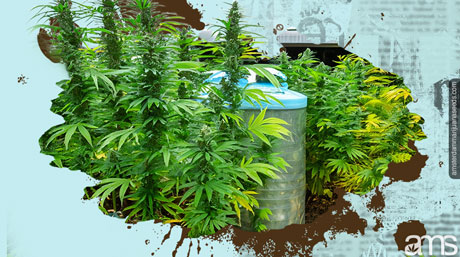
A store-bought rain barrel or a food-grade container both work. What makes the difference is how you set it up.
- Opaque and closed. Light through the walls feeds algae. A lid keeps out leaves, debris and insects.
- A first-flush diverter or roof washer. It sends the first run-off away and lets the cleaner water that follows into the barrel. A simple mesh at the top of the downspout catches leaves and twigs.
- Under a downspout, raised on a stable base. Height makes the tap easier to reach and gives a bit more pressure for a hose or can. A full barrel is very heavy, so the base has to be solid.
- An overflow that goes somewhere. Lead it away from your foundation and away from your plants.
Rutgers also describes treating the barrel against pathogens with household unscented bleach (5 to 6% chlorine) at 1/8 teaspoon per gallon, then waiting about 24 hours before use (Rutgers FS1218). That was written for vegetable gardens. Chlorine is exactly what many growers wanted to avoid by using rain, so whether you do this is your call. If you skip it, use the water fresh and clean the barrel more often.
Mosquitoes and standing water
Standing water in summer is where mosquitoes breed. The CDC advice for anything that holds water at home is to empty and scrub, turn over, cover or throw out such items once a week (CDC mosquito prevention). For a barrel that means a tight lid, fine mesh over every opening including the overflow, and using the water rather than letting it sit for weeks. A barrel you use up and refill is cleaner than one that sits full all summer.
Watering your plants with it
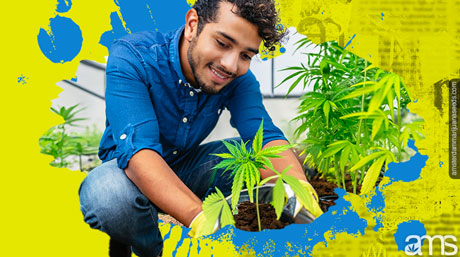
Rainwater changes what is in the water. It does not change how you water. The usual rules still apply.
- Water slowly at the base so it soaks in rather than running off the top.
- In pots, water until a little comes out of the bottom, then empty the saucer. Roots sitting in water is how root problems start.
- Let the top layer of soil dry before the next watering. Fast-growing vegetative plants drink more than small seedlings, and a big plant in a small pot dries out fastest.
- Bring indoor water to room temperature first. Water straight from an outdoor barrel in spring can be much colder than the soil in your tent.
How much and how often depends on pot size, medium, temperature and plant size, so there is no single number. Our guides on how much water cannabis plants need and watering and irrigation go into that in detail.

Reading the plant
Overwatered and underwatered plants can both droop, which confuses a lot of beginners. Lift the pot. A heavy pot with drooping leaves points to too much water. A light pot with limp leaves that recover within hours of watering points to too little. If you switch from tap to rain and see new pale or spotted leaves a few weeks later, look at pH and calcium and magnesium before you blame anything else.
Our view
We grew and keep all our own base genetics, and every strain we sell has been grown here at least once. Some of us have close to 40 years of growing behind us. Our view on rainwater: it is more natural, not automatically better. Soft rainwater gives you control. Hard tap water with a known pH can work just as well. What matters is that you know what is in your water and adjust for it.
Outdoor growers in wet regions get plenty of rain on the plants anyway, and there the bigger worry is mold on the buds, not the barrel. See growing cannabis in a wet climate and water quality for growing if you want to compare water sources further.
Growing cannabis is legal in some countries and regions and not in others, and the rules change. Check the law where you live before you start.
If you are ready to put a barrel to use, have a look at our feminized seeds from Amsterdam Marijuana Seeds. Our advice to every grower: do it with passion, not for the money.