Cannabis Strains for Eastern Europe: Frost Dates First
Short answer: in the northern half of Eastern Europe (Poland, Czechia, Slovakia and the Baltic states), the outdoor season is the limit, not the strain's potency. Plants have to go out after the last spring frost and be cut before autumn frost and rain spoil the buds. That is why we generally point growers in the north to autoflowers, and to photoperiod strains only when they are known to finish early. Further south, in the Balkans, the season is long enough for strains that flower later.
Below: how to read your own season, what it means for the type of seed, and which strains from our range fit, using figures from our own catalog.
Start with your frost dates, not with a strain list
The single most useful number for an outdoor grower is the window between the last spring frost and the first autumn frost where you live. Everything else follows from that.
For Poland there is good data. A study of 52 stations of the Polish meteorological institute IMGW-PIB over 1971–2020 found that, averaged over the whole country, the last ground frost in spring falls on May 14 and the last air frost on April 27. In autumn, the first ground frost comes on average on October 1 and the first air frost on October 14 (Nidzgorska-Lencewicz et al., Agriculture, 2024). Ground frost is measured 5 cm above the ground, roughly where a seedling sits, so for planting out the May date is the one to watch. These are national averages: your own region can be weeks earlier or later.
For Czechia, a study of the Elbe River lowland, one of the warmer farming areas, looked at daily minimum temperatures from 1961–2011. It found a 25% chance of dangerous spring frost when planting field vegetables after 3 May, dropping to 10% after 15 May (Potop et al., Natural Hazards, 2014). Higher ground in Czechia is colder than this lowland, so treat mid-May as the earliest sensible moment, and later on higher ground.
For Estonia, Latvia and Lithuania we could not find one recent official figure that covers all three countries the same way, so we do not give one here. Your national weather service publishes local climate normals; look up the average last and first frost for the station nearest to you.
What this means in practice: in much of Poland and Czechia, a plant set out in late May has until somewhere around early or mid October before frost becomes a real risk. Rain and cold nights in late September can cause problems before that, because dense buds that stay wet are where bud rot starts.
Why autoflowers suit the north
A photoperiod plant starts flowering when the days get shorter. Outdoors in Central and Eastern Europe that means flowering starts in late summer and the harvest falls in autumn, whatever date you planted. If the strain needs a long flowering time, harvest can land in the wettest and coldest part of the season.
An autoflower flowers by age instead. You can plant it after the last frost and harvest in summer, while the weather is still warm and dry. That is the main reason our advice for short northern summers is: start with autoflowers. It is our own view as growers, not a law of nature. A photoperiod strain that finishes early can do very well in the same place, and a cold, wet summer is hard on any plant.
Some points that follow from this:
- Do not plant out too early. An autoflower has a fixed life span. A plant that sits in cold soil for its first weeks loses time it never gets back.
- Give autoflowers their final pot from the start. Transplanting costs them days they cannot spare.
- Use the warmest spot you have. A south-facing wall, a balcony or a small greenhouse adds a little warmth and keeps the worst rain off.
- Watch the weather from September on. For photoperiod plants, be ready to harvest a little early rather than lose the crop to mold.
For background, see What are autoflower seeds, Feminized or autoflower, the outdoor transplant guide, Growing weed in cold climates and Growing in a temperate and wet climate.
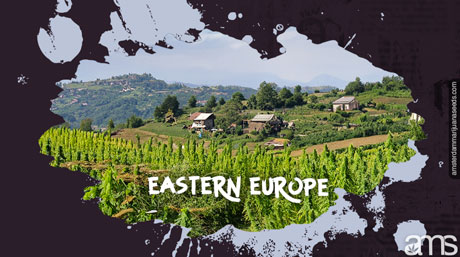
The south of the region: more room
In the Balkan countries, such as Bulgaria, Serbia, North Macedonia and Albania, and in the warmer lowlands of Hungary and Romania, summers are longer and hotter. That gives room for photoperiod strains with a longer flowering time, and for sativa-leaning strains that like warmth. Heat and dry spells become the bigger challenge there, so water early in the day and keep pots out of the hottest afternoon sun. Our guides on growing in a hot and dry climate and Mediterranean climates go into this.
We have not found one comparable frost data set for these countries, and conditions differ a lot between coast, plain and mountains. The same rule applies as in the north: look up your local frost dates first.
What we look at when choosing a strain for a short season
At Amsterdam Marijuana Seeds we grow all of our base genetics ourselves, and every strain in our range has been grown by us at least once. Some of us have been growing and breeding for close to 40 years. For a short season we would look at three things on the product page, in this order:
- Seed type. Autoflower first in the north. Feminized photoperiod only when the flowering time is short.
- Flowering time and outdoor harvest. If the outdoor harvest is listed for late October, that is after the average first air frost in Poland. Possible in a good year or a greenhouse, risky in an open garden.
- The climate tag. Each product in our catalog lists the climates it is suited to. For the north, look for Cold or Continental.
Regular seeds (male and female) are mainly for growers who want to make their own seeds. For a first outdoor grow, feminized or autoflower seeds save you from having to spot and remove males.
Strains from our range, by region
All figures below come from our own catalog. Growing results always depend on the weather, the spot and how you grow.
North and Central: Poland, Czechia, Slovakia, the Baltic states
- Northern Lights XTRM Autoflower: climate tag Cold, Mediterranean, Warm Dry; difficulty Easy; flowering time listed as fast (6-10 weeks).
- Super Skunk Autoflower: climate tag Cold, Continental, Mediterranean, Temperate; difficulty Easy.
- Habiba Autoflower: climate tag Continental, Temperate, Warm Dry; 100% indica; the product page gives 6-7 weeks of flowering; up to 17% THC.
- Northern Lights XTRM (regular seeds): climate tag includes Cold; around 8-9 weeks flowering indoors, but the product page puts the outdoor harvest at the end of October. In an open garden in the north that is late, so we would grow this one in a greenhouse or indoors, or choose the autoflower version above.
Hungary, Romania, Moldova, Ukraine
- Bianca (regular seeds): climate tag Continental, Mediterranean, Warm Dry; difficulty Easy; 7-8 weeks flowering; outdoor harvest in September and October according to the product page. Its parents include Afghan and White Queen (which flowers in about 8-9 weeks).
- White Widow XTRM (regular seeds): climate tag Continental, Mediterranean, Temperate, Tropical, Warm Dry; 8-9 weeks flowering; up to 150 cm tall outdoors.
South: Bulgaria, Serbia, North Macedonia, Albania
- Amnesia Trance Autoflower: sativa-leaning (35% indica / 65% sativa); climate tag Mediterranean, Temperate; flowering from about 8 weeks; up to 21% THC.
- Strawberry Ice Feminized: 80% sativa; climate tag Mediterranean, Tropical, Warm Dry; up to 23% THC. A strain for a long, warm season, not for the north.
Before you plant: the law
Cannabis laws differ from country to country in this region and they change. This article is about climate and plants only. It does not say that growing cannabis is legal where you live. Check the current law in your own country before you buy seeds or plant anything.
Browse all our marijuana seeds to compare more strains by climate tag and flowering time.